Universal Cart: What Google's AI Shopping Cart Means for Retailers
Christian Beeking
Co-Founder, Cloudginny
August 19, 202612 min read
As of 19 August 2026. This topic is moving fast, we update this article continuously.
Since Google I/O in May 2026, online retail has a new fundamental topic: the Universal Cart, Google's cross-merchant AI shopping cart. The trade press is reporting, Google is publishing developer documentation, and retailers are asking themselves whether they need to act now or can watch from the sidelines for a while. The honest answer sits in between. In this article we explain how the AI shopping cart works, which protocols sit behind it, when it will realistically reach Germany and which groundwork already pays off today, whatever the launch date turns out to be.
What is the Universal Cart?
The Universal Cart is Google's cross-merchant AI shopping cart. Users collect products from different online shops in Google Search, the Gemini app, on YouTube or in Gmail in one shared cart and complete the purchase in a single checkout. It was presented at Google I/O in May 2026.
That sounds like a convenience feature, but it is a change of architecture. Until now Google's role ends with the click: the user sees a Shopping ad or a free listing, clicks and buys in the retailer's shop. With the Universal Cart, the purchase moves into Google's surfaces, and AI agents can take over parts of the shopping, from comparing to paying. The retailer legally remains the seller (merchant of record), ships and supports as before, but loses the moment in which the customer walks through their shop.
Understanding how the Universal Cart relates to today's Shopping ecosystem takes some grounding in feeds and campaigns. If that is missing, read our Google Shopping guide first, this article builds on it.
Where it runs today and when it reaches Germany
Google is rolling the system out in stages, first by surface, then by country:
Region
Status
USA
Live: Universal Cart in Search and the Gemini app, agentic checkout. YouTube and Gmail follow as the next surfaces
Canada, Australia
Checkout expansion announced
United Kingdom
During the course of 2026
Germany / DACH
Not announced
Germany does not appear in Google's announcement. The sequence still tells you something: Google works its way through the English-speaking markets before translation, local payment methods and above all European regulation enter the picture. In the EU, Google's Shopping innovations have historically arrived late, because the Digital Markets Act forces additional review. Our assessment, clearly marked as such: nothing happens here before 2027, and after that it depends on Brussels at least as much as on Mountain View. For retailers that is not an all-clear, it is preparation time, and that time is valuable.
How agentic checkout works: the two paths
Behind the term agentic checkout sit two different flows.
The first path: the human buys, Google bundles. A user discovers products in different places, a pair of shoes in Search, a jacket in a YouTube video, and puts both into the Universal Cart. In the end they pay once, and behind the scenes this becomes separate orders with the respective retailers. The customer still decides, only the closing step moves to Google.
The second path: the agent buys on your behalf. The user issues an instruction with rules, for example “buy these running shoes in size 44 as soon as the price drops below €90”. The agent monitors, compares and completes the purchase once the conditions are met. To keep this from running out of hand, the user defines limits up front: which brands, which products, which budget. Only when every criterion fits is the transaction executed. For retailers the second path is the more far-reaching one, because here no person compares offers any more, a machine does, and it reads data fields instead of advertising promises.
The three building blocks: Universal Cart, UCP and AP2
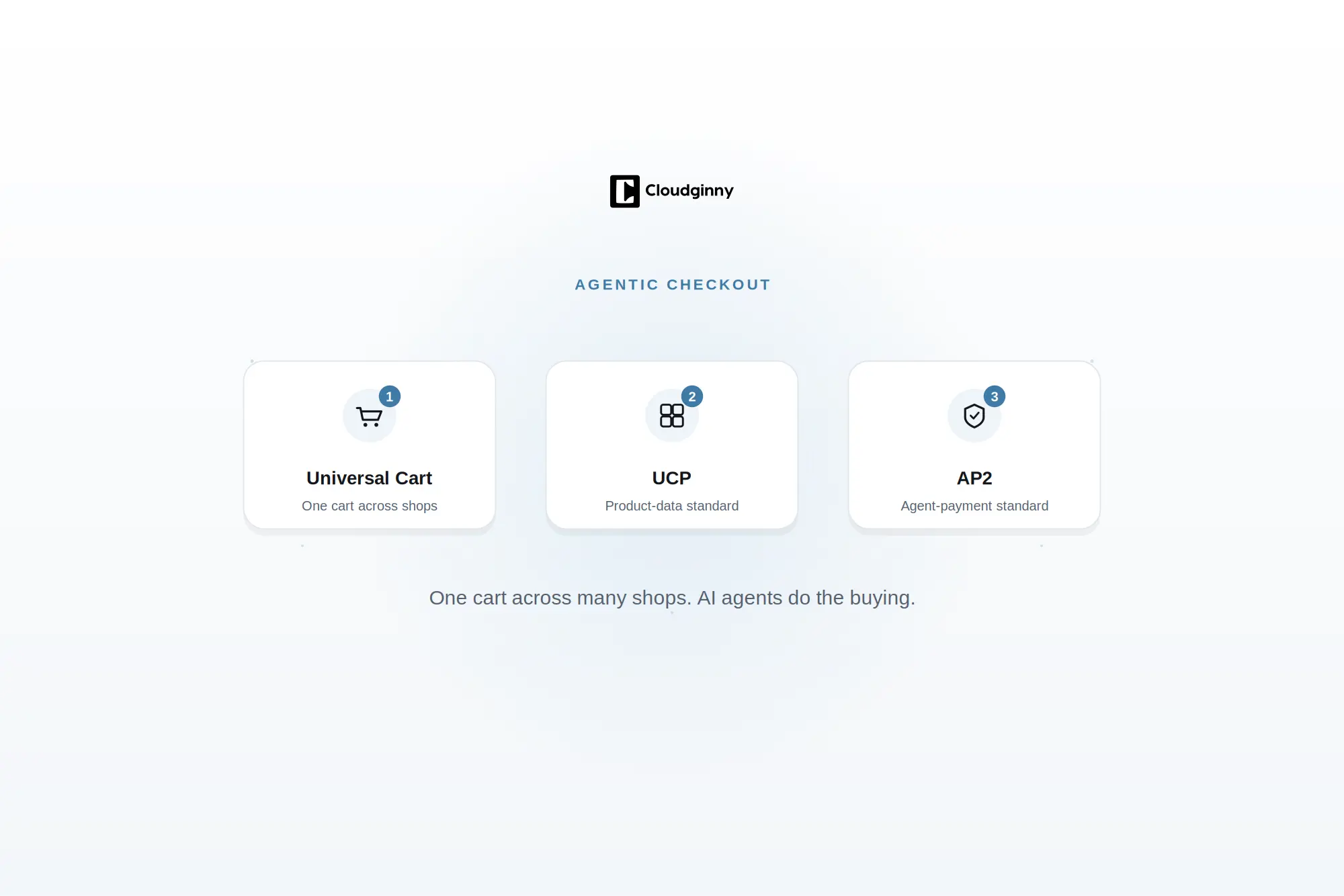
Technically the system consists of three parts that often get mixed up:
Collect products from different retailers and complete them in one checkout
UCP (Universal Commerce Protocol)
Open standard that Google developed together with Shopify. According to heise, Amazon, Meta, Microsoft, Salesforce and Stripe are involved as well
The shared language through which AI agents read product data, check availability and trigger checkouts
AP2 (Agent Payments Protocol)
Standard for payments made by AI agents
Securing the transaction: the user defines what an agent may buy with which budget, and payment happens only within those mandates
A note on the naming confusion: Google's German blog page wrongly calls AP2 the “Agentic Commerce Protocol”. The English source calls it Agent Payments Protocol, and that is what we stick to, because Agentic Commerce Protocol is the name of an entirely different standard, more on that in a moment.
UCP against ACP: two competing standards
Google is not alone with the idea. OpenAI and Stripe have published their own standard with the Agentic Commerce Protocol (ACP), which powers Instant Checkout in ChatGPT: users buy right inside the chat, without visiting the retailer's shop. That leaves two protocols facing each other, UCP in the Google camp, ACP in the OpenAI camp, and the outcome is open.
What is telling is who plays where. Shopify supports both worlds, Stripe co-developed ACP and appears on the UCP contributor list at the same time. The big infrastructure providers are not betting on one camp, they are keeping both doors open. For an individual online shop it would accordingly be premature to put development budget into exactly one protocol. The smarter reading of this format conflict: both standards work with the same ingredients, namely structured, complete, up-to-date product data. Whoever has that can serve any protocol later. Whoever does not is invisible in both worlds.
What changes for Shopping Ads and free listings?
The question that matters most to advertisers is one hardly any report answers: what happens to running campaigns? As things stand the answer is nothing, and that is not a reassuring platitude. Shopping Ads and free listings continue unchanged, the Universal Cart is not active in Germany, and even in the USA it does not replace the ad formats, it builds on them. Google earns from commerce through advertising and will carry that revenue source into the new surfaces, first ad integrations in AI answers are already running.
In the medium term, though, what creates visibility does shift. Today retailers compete for ad slots through bids, feed quality and price. In an agentic world a second competition appears alongside: agents pick products by data, availability, price, attributes, delivery time. The product feed, already the foundation of every Shopping campaign today, thereby becomes the interface for both worlds. Whoever has their campaigns and their feed under control automatically plays in both systems, creating Google Shopping campaigns with Cloudginny shows how that works without agency overhead.
Requirements: what a shop needs technically
Taking part in agentic checkout is developer work, not a checkbox in the Merchant Center. That sets the Universal Cart apart from everything retailers know from the Shopping setup, and it should be said plainly.
Concretely, the UCP specification (protocol version 2026-04-08) asks three things of a shop: a publicly retrievable profile at /.well-known/ucp, the declared capability dev.ucp.shopping.cart and a POST /carts endpoint through which agents can create carts. Translated: the shop needs an API layer that Google's agents can address programmatically, and somebody has to build and run it.
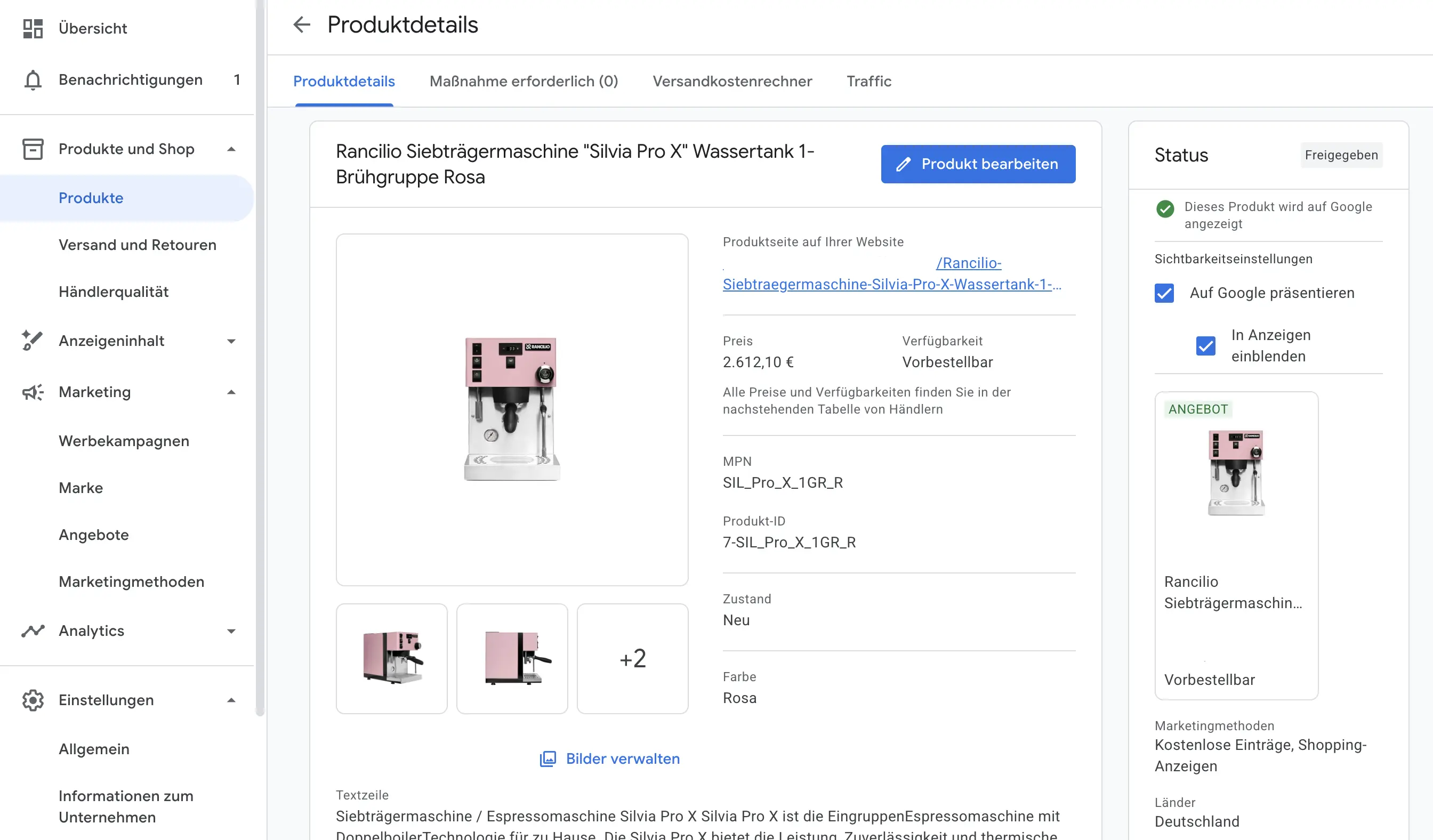
Price, availability, condition, colour, MPN: what determines Shopping visibility today is the data basis for AI agents tomorrow.
The good news for most retailers: hardly anyone will have to build this themselves. Shopify is a launch partner and will deliver UCP support at platform level, so Shopify merchants will presumably get the technology handed to them. For JTL, Shopware and other systems the rule is: wait and see what the shop system and plugin vendors deliver before your own development budget flows. What nobody handles for you, though, is the data underneath. A feed full of disapproved products stays invisible via API too, the most common reasons for disapproval and their fixes are here: Products disapproved in the Merchant Center: the top 3 reasons.
What retailers should already be doing
No frantic action, but no looking away either. This order pays off whenever the Universal Cart reaches Germany:
Complete your product feed: GTINs, brands, attributes and meaningful titles for the entire range. Agents compare data fields, empty fields are lost comparisons.
Work through disapproved products: in our analysis this affects under one percent of the feed at the median, but when it strikes, it strikes by category, one outlier sat at 28 percent. Every disapproved product is invisible in Shopping today and invisible to agents tomorrow.
Keep prices and stock in sync: daily feed updates, so that feed, shop and reality match. An agent that finds an outdated price aborts the purchase.
Structure Shopping campaigns cleanly and prioritise products actively: across our client accounts only a good third of approved products gets served at all at the median, and clearly less with large catalogues. Without steering, Google alone decides which products those are, with segmentation by margin or product group you decide with it.
Follow the platform roadmap: Shopify merchants first, everyone else watches for when their shop system announces UCP support.
Do not commit development budget before the DACH launch: the protocols are young, the standards fight is open, and the groundwork from points 1 to 4 goes to waste in no scenario.
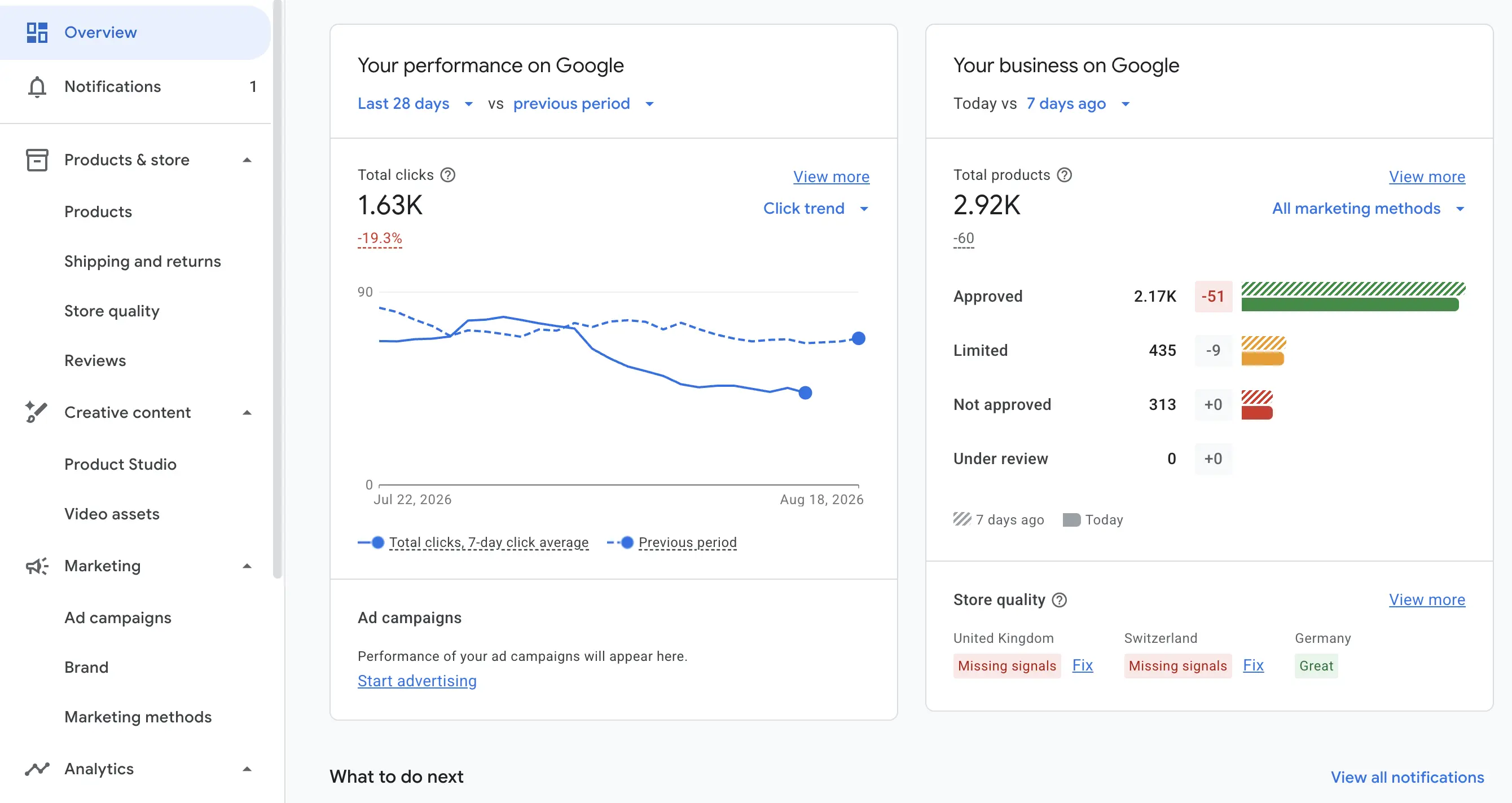
And this is what it looks like when it does strike: of 2.92K products, 313 are not approved and another 435 only run with limitations.
Points 1 to 4 are exactly the work that decides the success of Shopping campaigns today, which is why Ginny handles them for our customers in day-to-day operation. Which AI tools come into question for that in general is something we compared here: Which AI marketing tools are best in 2026?, and what it looks like in a real account is shown by the Aventon case study.
Risks: customer relationship, data and interchangeability
For all the preparation, what retailers should view critically about this model belongs on the table too.
The biggest risk is the customer relationship. If the purchase happens in Google's surface, the shop visit falls away and with it everything attached to it: newsletter sign-up, cross-selling, recognition, brand experience. The retailer becomes the delivery address behind a Google interface. They remain merchant of record with all the obligations, but the customer may well remember Google rather than the shop they bought from. And when agents compare primarily by price and data fields, interchangeability grows: switching providers costs the agent nothing.
On top of that come two points the trade press rightly leaves open. The liability question in autonomous purchases is unresolved: who carries the damage when an agent orders wrongly, the user, the retailer, Google? There are no binding answers so far. And Google runs into a structural conflict of interest when it operates the platform and tells the agent which product is best at the same time. How neutral a recommendation can be when the recommender earns from it through advertising is a fair question, and one regulators will ask too.
What follows from this in practice: your own data sovereignty and direct customer channels become more valuable, not less important. Whoever already has AI systems working for them, instead of merely appearing inside other people's AI systems, keeps more control, and we took the difference between the two apart here: AI agent for Google Ads: campaign management with AI compared.
Frequently asked questions about the Universal Cart (FAQ)
Is the Universal Cart available in Germany?
No. The Universal Cart currently runs in the USA, the checkout is being extended to Canada, Australia and, during the course of the year, the United Kingdom. For Germany there is neither a date nor an announcement, a realistic start is 2027 at the earliest.
What is the difference between the Universal Cart and Google Shopping?
Google Shopping displays products and sends buyers into the online shop with a click, the purchase happens at the retailer. The Universal Cart moves the purchase into Google's surfaces: products from several retailers land in one cart and are paid for there, the shop visit falls away.
What are UCP and AP2?
UCP (Universal Commerce Protocol) is the open standard through which AI agents read product data and trigger checkouts, developed by Google and Shopify. AP2 (Agent Payments Protocol) secures the payments: it defines what an agent may buy on the user's behalf with which budget.
What is the difference between UCP and ACP?
Two competing standards for the same problem. UCP comes from the Google camp (with Shopify), ACP from OpenAI and Stripe and sits behind Instant Checkout in ChatGPT. Which one prevails is open, large providers such as Shopify and Stripe support both as a precaution.
Do I remain the customer's contractual partner as a retailer?
Yes. Even when buying through the Universal Cart, the retailer remains merchant of record, legally the seller with all obligations from invoice to warranty. Google brokers the purchase but does not conclude it in its own name.
Do I have to do anything as a retailer right now?
No development project, but groundwork: complete your product feed, fix disapproved products, keep prices in sync and structure your Shopping campaigns cleanly. This work improves performance today and is at the same time the entry condition for every agentic platform, whichever protocol prevails.
Christian Beeking is co‑founder of Cloudginny, the AI agent for automating Google Ads in e‑commerce. Before Cloudginny, the team managed more than 100 million euros in Google Ads budget for brands such as MediaMarkt, Cisco and Bose, and has now poured that knowledge into Ginny. Cloudginny is an official Google Partner, a WebStollen partner and part of the German Accelerator.
Search for "Google Ads audit" and what you mostly get is offers: agencies that will examine your account for free, and a contract at the end. That does not answer the question underneath: what is actually being checked, how much of it can I do myself, and what does the rest cost? This article walks through the nine areas of an audit, says for each one where the money typically leaks, and attaches a checklist you can tick off.
Ryze AI is the cheaper multichannel autopilot: $89 flat for Google, Meta, TikTok and LinkedIn. Cloudginny is a Google Ads specialist with a German company behind it, Merchant Center depth and an approval model. This comparison puts prices, channels and control side by side, and says plainly where Ryze wins.
Search for Google Ads management software and you land on Optmyzr, Adalysis or Opteo. They are good tools, just built for somebody who already knows Google Ads: a marketer who writes rules and knows what to do with forty improvement suggestions. Most online shops do not have that person. This article explains what the classic platforms actually do, what an AI agent does differently, which model fits when, and what neither of them can do.