Last updated 20 September 2026. Prices for other providers come from their public pages, retrieved in September 2026.
TL;DR
PPC tools make experts faster. Rules, audits and suggestion lists only help if someone knows Google Ads and judges every recommendation.
An AI agent does the analysis for you. It hands you finished decisions with reasoning and the expected impact, ready for approval.
Which one fits depends on who runs the account. Agencies with many accounts and teams with their own PPC manager do better with a tool, online shops without that role with an agent.
Neither replaces your business decisions. Margin, product range, ROAS target and clean tracking stay with you.
The short answer
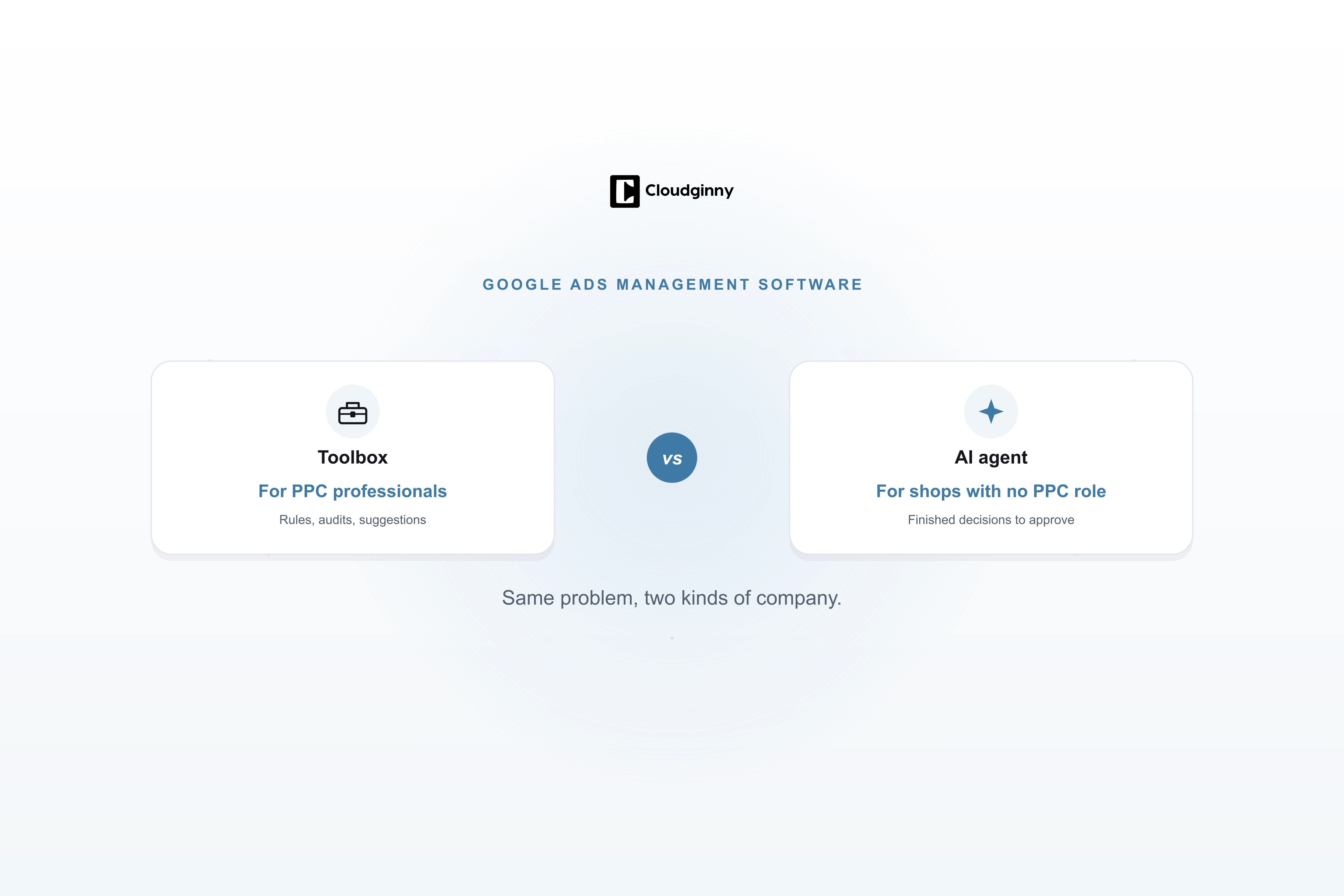
A PPC management platform is a toolbox for somebody who already knows Google Ads: it makes a professional faster. An AI agent is built for shops where nobody works in the ad account every day: it takes over the analysis and puts finished decisions in front of you. Both categories solve the same problem for two different kinds of company.
What a PPC management platform actually does
The established tools share a core of five building blocks, but they weight them very differently.
Rules and scripts: you define conditions and actions, such as “pause campaigns whose CPA rises above 40 dollars” or “raise the budget when impression share drops”. Optmyzr is the benchmark here, with a rule engine that accepts any combination of metrics, a script library and one-click optimisations that bundle prepared changes.
Alerts and audits: the system checks the account continuously against a catalogue of known problems and reports anything out of line. Adalysis has made that its core product, with more than a hundred daily checks from keyword conflicts through broken URLs to drops in quality score, plus automated ad tests that pick winners by statistical significance.
Suggestions: instead of writing rules, you get a list of prioritised improvements and apply them with a click. Opteo represents that model, with around forty improvement types from keyword maintenance through bids to Shopping ads. It is the most accessible of the three, and it still assumes you can judge each suggestion on the merits.
Bulk changes and reporting: changes across many campaigns or accounts in one step, plus reports for clients or management. For agencies with twenty accounts or more, that is often the actual reason to buy.
What all three have in common is something even neutral comparisons state plainly: they amplify a human operator, they do not replace one. Somebody has to decide and apply. If you do not have that person, you need a different category.
What an AI agent does differently
The click at the end looks the same in both. What differs is the work before it. A toolbox shows you that the search term “free” cost 340 dollars and converted nothing, and leaves you to work out what follows. An agent has already done that analysis, knows what follows from it in an e-commerce account, and puts the finished decision in front of you: exclude this term, estimated saving this much per month, approve or reject.
Concretely with Ginny, our agent: the analysis runs daily across search terms, products, budgets and Merchant Center status. What comes out is a handful of proposals in plain language with a reason and a figure in euros, rather than raw data or a list of forty improvement types. You read, you decide, Ginny applies. Reversible safety measures such as excluding a search term with no conversions she handles immediately and logs; anything that costs money or turns on delivery waits for your approval.
The second difference is the fit. The classic platforms are built for any kind of Google Ads account: lead generation, software, local services. An agent for online shops knows the product feed, the Merchant Center, disapproved products and promotions as part of everyday work, not as an add-on module.
Cloudginny is not the only provider in the agent category. Ryze AI, for instance, runs Google, Meta, TikTok and LinkedIn fully autonomously with no approval step, while Adstudio goes multichannel with human approval. Within the category the differences come down to two questions: how much control the user keeps, and whether the system is built for e-commerce or for any kind of account. If you want to find your way around the agents, the differences are set out on our comparison pages.
The comparison in one table
Optmyzr
Adalysis
Opteo
Cloudginny (agent)
Who operates it
PPC professional or agency team
PPC specialist
Marketer with Google Ads knowledge
Shop owner with no PPC role
What happens without you
Only what you defined as a rule or script
Audits and ad tests run, applying them waits for you
Nothing, suggestions wait for your click
Analysis and proposals daily, safety actions immediately, everything else after approval
Entry price
from around 210 US dollars per month paid annually, smallest tier up to 25,000 US dollars ad spend
from around 149 US dollars per month, up to 50,000 US dollars ad spend, unlimited accounts
from 129 US dollars per month for 10 accounts and 25,000 US dollars ad spend
from 149 US dollars per month up to 2,499 US dollars ad spend
Setup
connect accounts, then build rules, scripts and alerts yourself
connect accounts, the check catalogue runs immediately
connect accounts, suggestions arrive immediately
connect Google Ads and Merchant Center, the first analysis runs automatically
Channels
Google, Microsoft, Amazon, Meta and LinkedIn to a limited extent
Google, Microsoft
Google only
Google, Microsoft as an add-on
Built for
Agencies and in-house teams with many accounts and their own processes
Search-heavy accounts with a lot of testing, agencies with many accounts
Freelancers and small agencies focused on Google
Small and mid-sized online shops selling into German-speaking markets with no PPC manager of their own
One detail in the price row says more about the target audiences than any description: Optmyzr's smallest tier is meant for accounts up to 25,000 US dollars in ad spend. That is ten times what our Starter plan covers. So the tools are not so much expensive as built for a different order of magnitude.
When the rule engine is the better choice
There are cases where an agent is the wrong tool, and they are worth knowing before you decide.
Agencies with many accounts. If you look after twenty client accounts you need bulk changes, multi-account reporting and a rule engine that rolls the same logic out across all of them. That is what Optmyzr is for, and an agent built for individual shops cannot replace it.
Mature processes of your own. If you have spent years building rules and scripts that work, do not trade them for a different model. Migrating automation that already works, just because the new system sounds more modern, is a bad trade.
Cases outside e-commerce. Lead generation, software, local services, B2B with long decision cycles: there is no product feed, no Merchant Center and no order values there for a shop agent to anchor its decisions to. The generic tools are the right choice.
Systematic ad testing. If you run many text ads against each other and need statistically clean winners, Adalysis gives you that as a finished process.
Channels beyond Google and Microsoft. If you want to manage Amazon campaigns too, Optmyzr covers that. An agent for Google Shopping has no business there.
And the most honest case of all: if you have a good PPC manager, the rule engine is almost always the better choice. It makes a professional faster, whereas an agent tends to make a professional impatient, because it presents decisions they would have made themselves.
When the agent wins
The agent wins for a single profile, and for that one it wins clearly: the online shop with no PPC role of its own. The owner or the marketing lead has three other jobs, the ad account runs on the side, and nobody has time to write rules or weigh up forty suggestions. That profile falls through the cracks with the classic platforms, because they assume exactly what this shop is missing.
Three things reinforce it. A product feed, because then an agent that understands the Merchant Center natively pays off. An ad budget below the tiers the classic platforms are built for. And a German-speaking team, because the three tools named above work in English.
What that looks like in a real shop is shown by Nähplatz.de, a JTL shop for sewing machines and accessories. After years with agencies the team had stopped everything and tried Google Ads themselves, reaching a conclusion many merchants will recognise: “It's incredibly complex to understand every corner of an ads account. The expertise simply wasn't there.” With an agent the team now runs the campaigns itself, has saved €10,674 against agency or freelancer costs and 345 hours of manual work, lifted revenue via Google Ads by 25 percent in the first quarter year on year, and keeps marketing costs permanently below 5 percent of revenue. The full story is in the case study with Nähplatz.de, and the prices for it are on our pricing page.
What neither can do
Neither the toolbox nor the agent takes away the questions that are about your business: what margin a product can carry, which range should be advertised, how much growth you are willing to pay for. Both work with the goals you give them, and no system corrects a wrong ROAS target.
Neither fixes a broken data foundation. Conversion tracking without dynamic order values makes any optimisation blind, no matter who performs it. Setting up tracking is a job for a person, usually with help from the shop system.
Neither produces images or video, builds landing pages or writes product descriptions for the shop. And neither replaces the decision about whether Google Ads is the right channel for this business at all.
Can you run both?
Technically yes, sensibly only in one configuration. Two systems actively changing the same account work against each other: an Optmyzr rule raises a budget that an agent was about to cut because performance was weak, and neither knows about the other. An agent's approval model softens that, because nothing happens without your click, but it makes you the referee between two systems, which is more work rather than less.
The configuration that does work: an agent for the day-to-day and a pure audit tool alongside it that changes nothing and only checks. That gives you a second opinion without the conflict. If you already have a PPC manager with Optmyzr, you do not need an agent. And if you have an agent, what you need instead of a rule engine is mainly one thing: a few minutes a day for the decisions it puts in front of you. For how tool costs stack up against an agency overall, see our comparison Google Ads agency vs. tools.
Frequently asked questions about Google Ads management software
What is the difference between a PPC management tool and an AI agent?
A PPC management tool such as Optmyzr, Adalysis or Opteo provides rules, audits and suggestions that somebody who knows Google Ads then judges and applies. An AI agent takes over the analysis and presents finished decisions with a reason, which somebody without Google Ads knowledge can approve.
Which Google Ads management software is the best?
It depends who operates it. For agencies with many accounts Optmyzr is the benchmark, for systematic ad testing Adalysis, for a simple list of suggestions Opteo. For an online shop with no PPC manager of its own, an agent is the category that fits.
What does Google Ads management software cost?
The classic platforms start between roughly 129 and 210 US dollars per month and scale by managed ad spend, with the smallest tiers intended for budgets from around 25,000 US dollars. Cloudginny starts at 149 US dollars per month for ad spend up to 2,499 US dollars.
Do I need Google Ads knowledge to use a PPC tool?
Yes. Writing rules, interpreting alerts and judging suggestions all assume you understand what is happening in the account. The tools make professionals faster; they do not turn beginners into professionals.
Can I use Cloudginny alongside Optmyzr or Opteo?
Two systems actively changing the same account work against each other. What makes sense is an agent for the day-to-day plus a pure audit tool that only checks. If you already have a PPC manager with Optmyzr, you generally do not need an agent.
Optmyzr, Adalysis and Opteo are trademarks of their respective owners. Information on prices and features comes from publicly available sources as of September 2026; the provider's own statements take precedence.
Christian Beeking is co‑founder of Cloudginny, the AI agent for automating Google Ads in e‑commerce. Before Cloudginny, the team managed more than 100 million euros in Google Ads budget for brands such as MediaMarkt, Cisco and Bose, and has now poured that knowledge into Ginny. Cloudginny is an official Google Partner, a WebStollen partner and part of the German Accelerator.
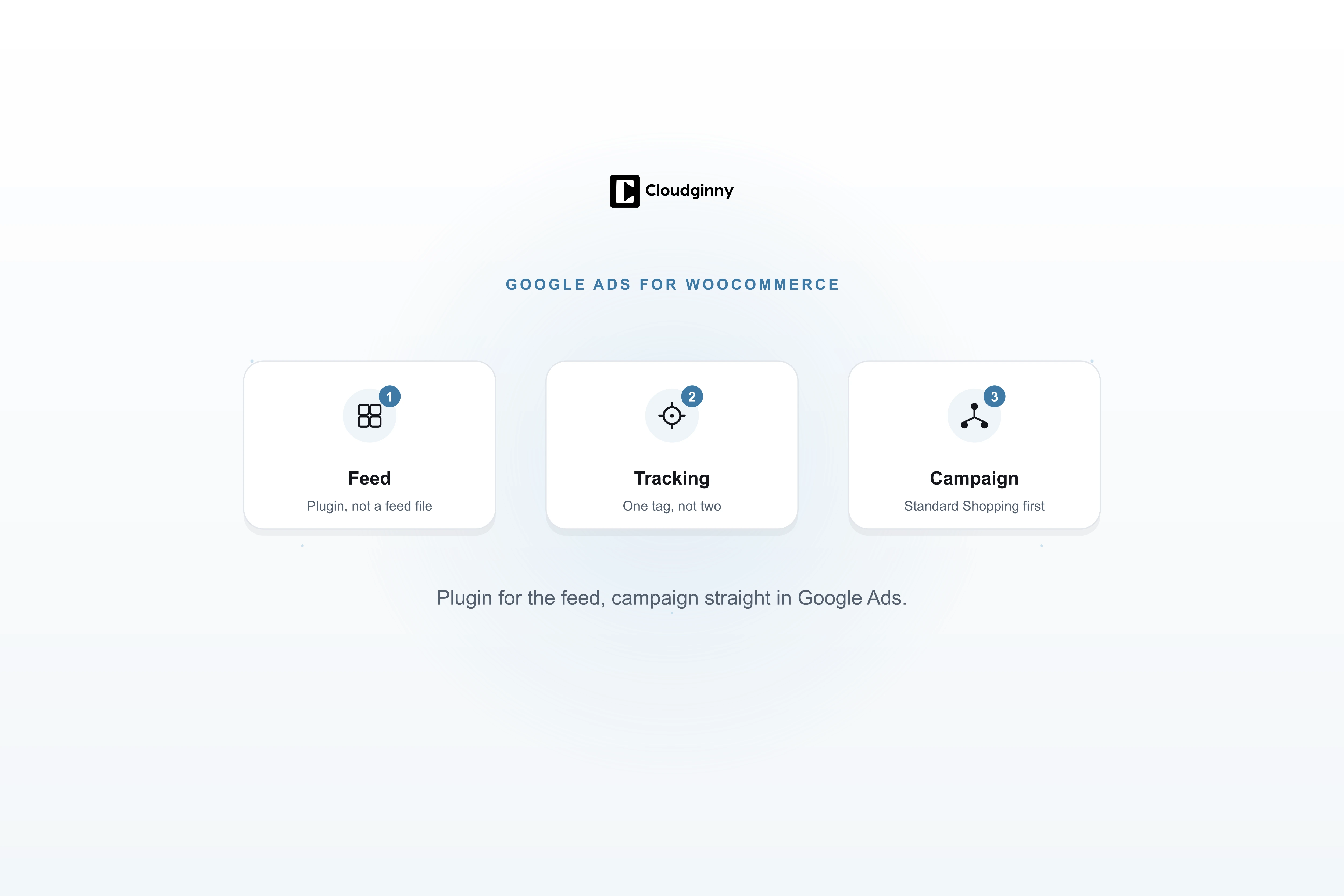
Most guides to WooCommerce and Google Ads date from the time when the plugin was still called Google Listings & Ads and free product listings showed up in Google Search. Both have changed. This guide shows the 2026 route: plugin or feed extension, shipping and unit price, tracking without double counting, the most common errors and why the campaign belongs directly in Google Ads.
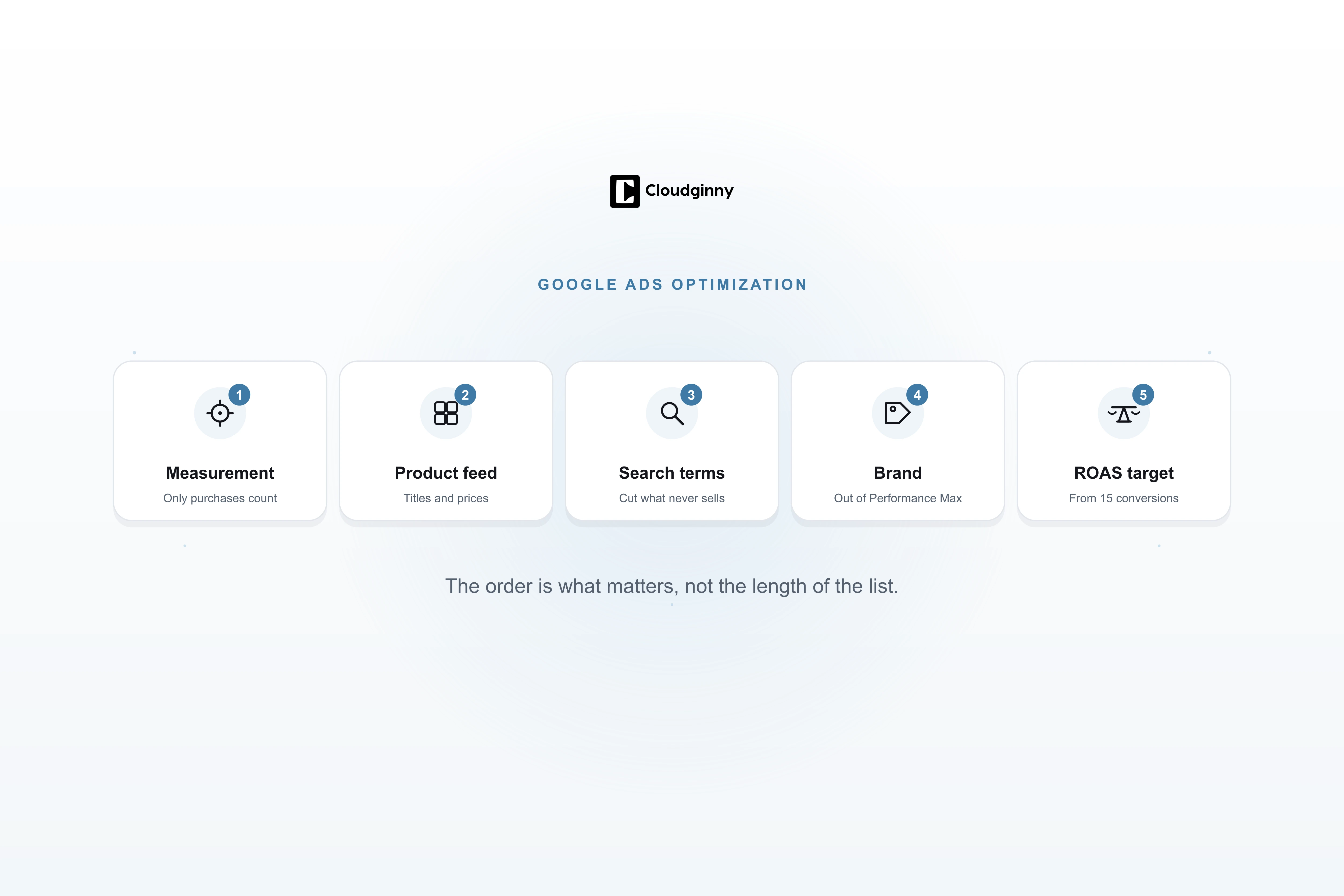
Most guides to Google Ads optimization are lists of ten equally weighted tips. In an online shop, though, the order decides: if you fine-tune bids while Google counts page views as sales, you only amplify the error. This guide shows the five levers in the order in which we tackle shop accounts, with figures from our customer accounts and the right rhythm for changes.
A Google Shopping agency only pays off from around $7,500 to $10,000 in monthly ad spend, and the feed tool, CSS fee and setup come on top of its fee. Most shops spend far less. This article covers what a Shopping agency really costs, what’s behind the promised 20 percent CSS savings, how to spot a bad offer and when an AI is enough for ongoing maintenance.