Google Ads Agency vs. Tools: What Actually Pays Off for Shops?
Christian Beeking
Co-Founder, Cloudginny
August 19, 20269 min read
Anyone who googles this question gets answers almost exclusively from agencies. That is a bit like asking the butcher whether you should eat less meat. The standard recommendation accordingly runs: from $2,000 to $3,000 in ad spend, please hire an agency, and what happens below that stays unanswered. We work the decision through here with open numbers, including our own prices, because yes, we have a horse in this race too. The difference: we put every number on the table and say honestly when each route pays off and when it does not.
Agency or tool: the short answer
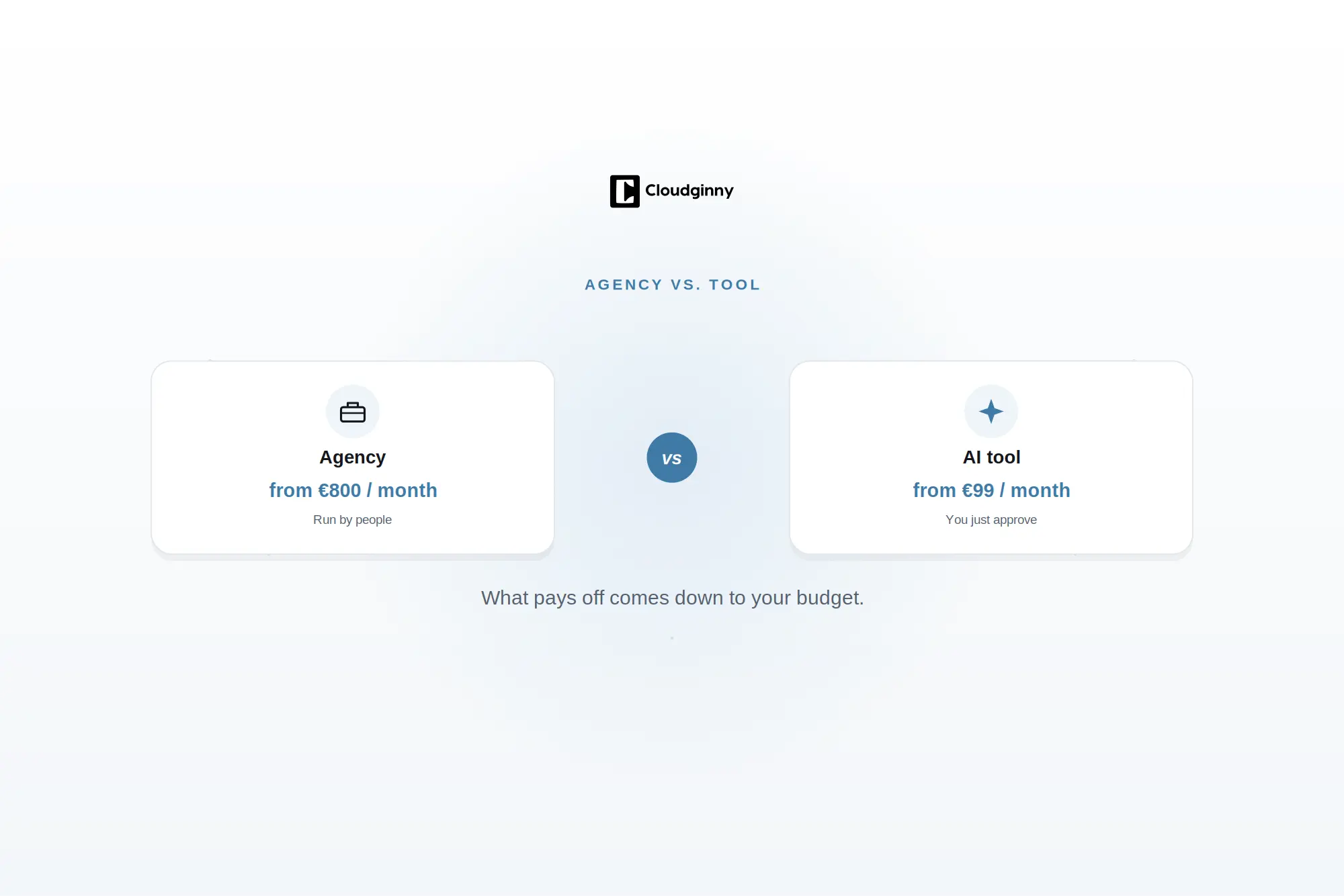
A Google Ads agency runs your account as a service and usually costs $800 to $4,000 in fixed fees or 8 to 15% of ad spend per month. An AI tool automates the same routine work for a low to mid three-digit monthly amount. The widespread equation that a tool means doing it yourself no longer holds for AI agents: you approve proposals instead of optimising yourself.
As a rule of thumb for online shops: below roughly $7,500 in monthly budget, an AI tool is almost always the more economical choice, because an agency retainer eats a double-digit percentage of the budget at that level. Above it, the agency becomes debatable as soon as complexity arrives that no tool covers: several countries, several channels, an in-house marketing team. The details and the maths behind that come next.
What an agency does and what it costs
A good agency takes over the entire account: setup and campaign structure, ongoing optimisation, search term maintenance, ad copy, reporting and ideally strategic advice on budget and season. You buy experience and hand over responsibility, in the best case to someone who has seen hundreds of accounts.
Payment follows one of four models, and the industry's price overviews consistently name these ranges: a monthly fixed fee of $800 to $4,000, a tiered price by budget size, a percentage model of 8 to 15% of ad spend (in the SME segment up to 20% is sometimes charged), plus almost always a one-off setup fee of $500 to $2,000. In the SME segment there are also smaller retainers from around $300 to $500, usually with a minimum term and a correspondingly reduced scope: at a $400 retainer you realistically get two to three hours of work per month, which covers a look at the dashboard, not active management.
The structural catch is none of the prices, it is the maths behind them: an agency scales through people, and people's time costs the same whether it looks after a $1,500 account or a $15,000 one. That is why small mandates do not pay off for agencies, and why the recommendations in agency guides all start at $2,000 to $3,000 in budget.
What a tool does and what it costs
Two very different things run under the word “tool”, and the distinction decides the whole debate.
Classic tools are instruments: rule editors, scripts, bid managers, reporting dashboards. According to market overviews they cost $50 to $300 a month and make you faster, but the analysis, the decisions and the execution stay with you. For this category the sentence that Google's AI overview also spreads holds true: cheaper than an agency, but you do the work yourself.
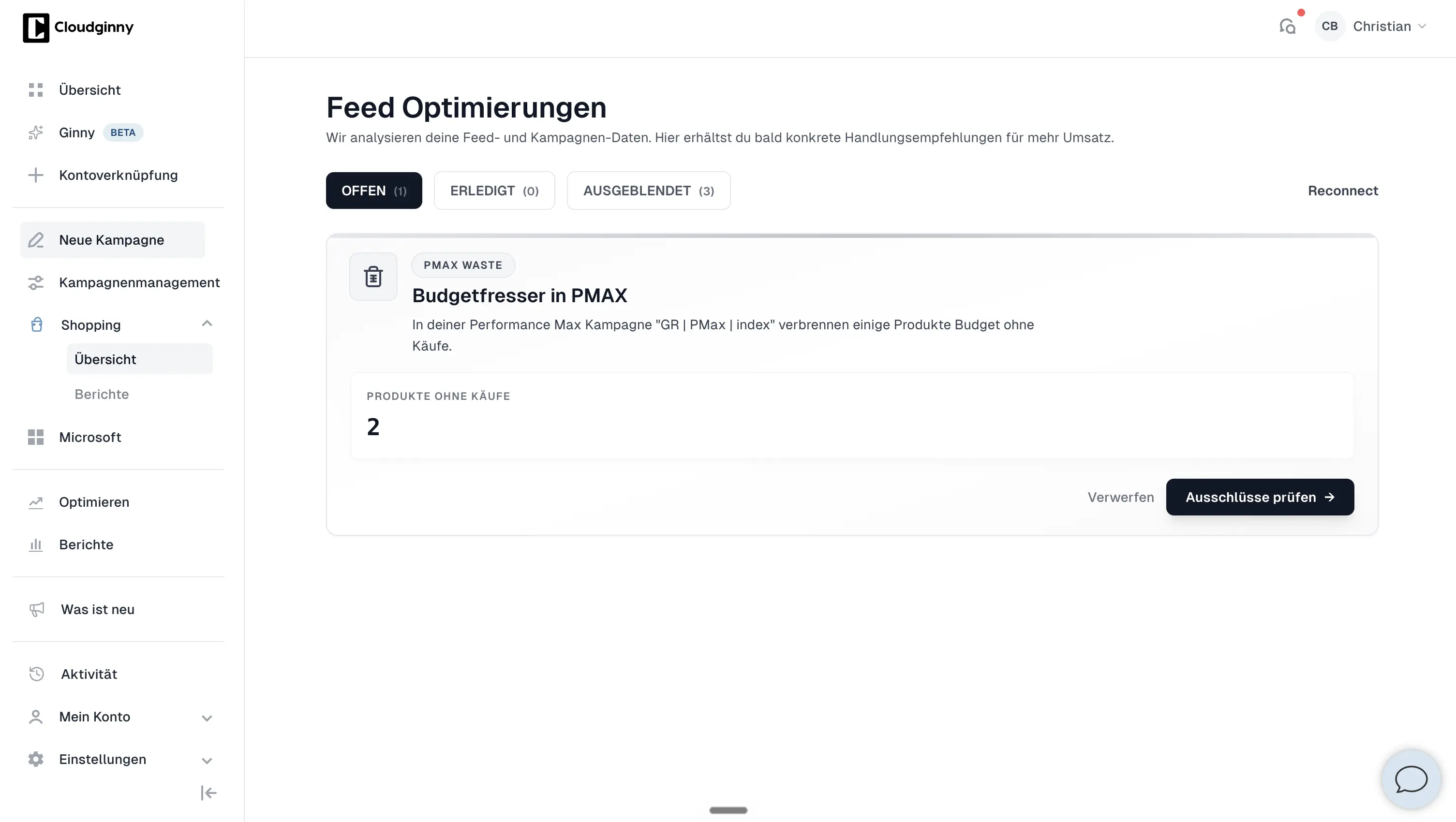
AI agents are the second category, and they work differently. Ginny, our AI agent, analyses the connected accounts daily, finds wasted spend, weak products and optimisation opportunities, and puts concrete proposals in front of you with a rationale and a euro impact. You approve, Ginny executes. Your effort is minutes a day for checking and approving, the analysis and execution happen without you. What Ginny can do in detail is on the product page.
The analysis runs along in the background: here Ginny found two products burning budget without selling anything.
Cloudginny's prices, net and without a setup fee: $149 a month up to $2,499 in ad spend, $349 up to $7,499, $699 up to $19,999, above that Enterprise from $1,200. The full overview: pricing that pays for itself. The reason an AI agent costs a fraction of an agency is the same one as above, in reverse: software scales without people's time, and a small account costs barely less to run than a large one.
The cost comparison in one table
First the ranges at a glance, each with its origin:
Model
Cost per month
Source of the range
Agency
$800 to $4,000 fixed fee or 8 to 15% of budget, plus a one-off $500 to $2,000 setup
agency price overviews
Do it yourself
$400 to $750 in time cost at a $50 hourly rate, and at realistic founder rates more like double
worked example from an agency guide
In-house manager
around $8,300 including tool licences ($100,000 a year)
worked example from an agency guide for a $15,000 monthly budget
Classic tool
$50 to $300, plus your own working time
market overviews
AI agent (Cloudginny)
$149 to $699, from $20,000 budget from $1,200
our public price list
And worked through at two typical shop sizes:
Cost route
At $3,000 monthly budget
At $15,000 monthly budget
Agency
approx. $500 to $1,000 (17 to 33% of budget)
approx. $1,500 to $2,500 (10 to 17%)
Do it yourself
$400 to $750 in time cost
no longer realistic alongside daily business
In-house
oversized
approx. $8,300
Cloudginny
$349 (12% of budget)
$699 (5%)
The percentages are the actual point: at a $3,000 budget you pay an agency a sixth to a third of your ad spend on top as a fee, before the first click is bought. What clicks, budgets and break-even cost in principle is in our guide Google Ads costs: what online shops should realistically budget in 2026, this article stays with the question of model.
“Tool” does not mean “do it yourself”: the most common error
Google's AI overview currently sums the tool question up like this: tools are cheaper but require “that you do the work yourself”. For classic tools that is true. For AI agents it is the central error of the whole debate, because it compares the agency with the toolbox and overlooks the third option that has only recently existed: software that does the work and leaves you nothing but the decision.
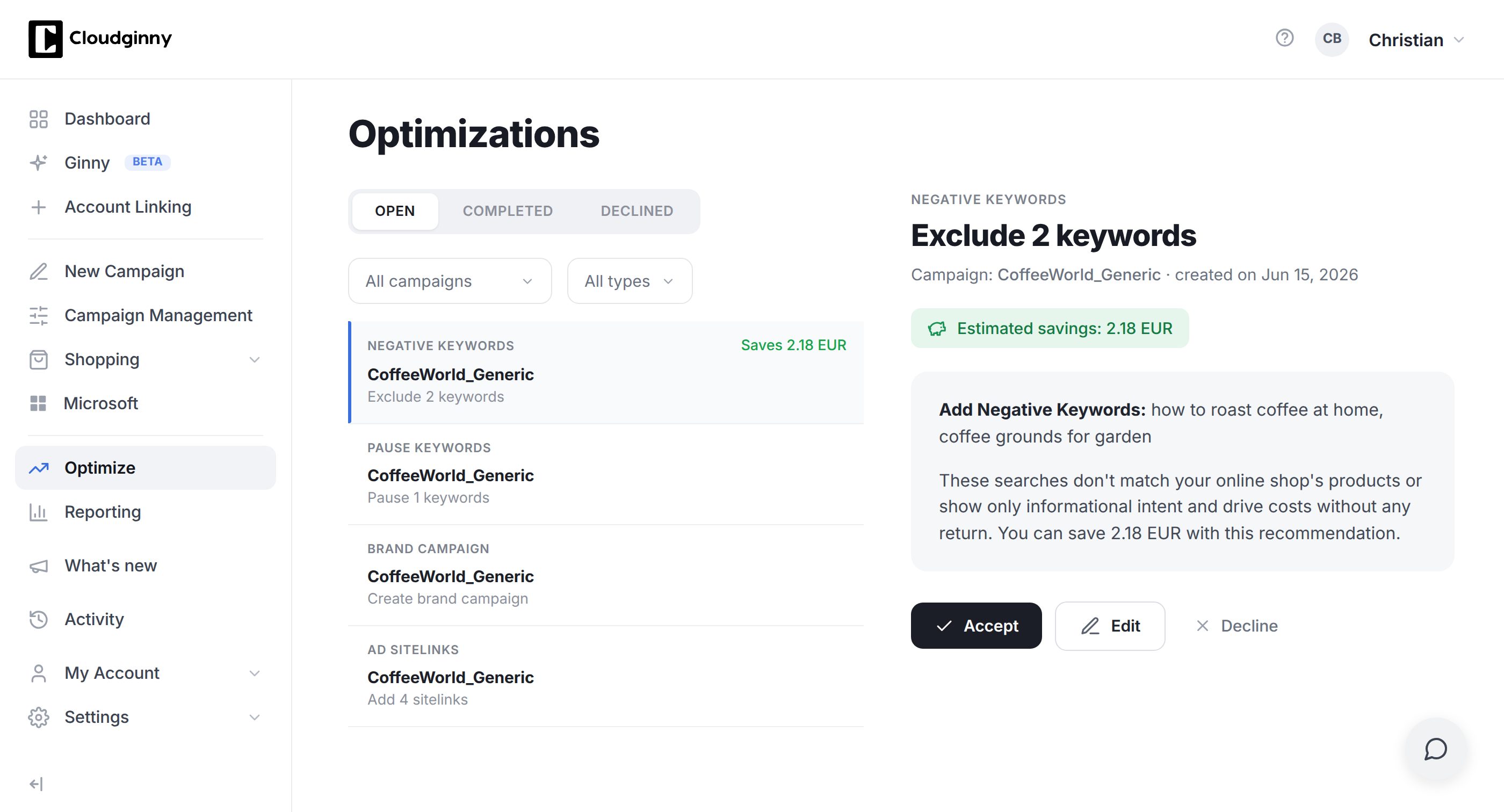
The difference can be pinned to a single week. With a classic tool, account maintenance means: go through search terms, look for anomalies, adjust bids, add exclusions, two to four hours, every week. With an AI agent the same week means: you get a handful of proposals with a rationale (“this search term cost $40 and never converted, exclude it?”), you tap approve or reject, done. The work has not disappeared, it has moved.
Exactly that week in one picture: proposal, rationale, euro impact, and your decision in a single tap.
One agency guide boils it down to the formula “automation replaces work, not strategy”, and the sentence is right, it just draws the wrong conclusion. Strategy, meaning margin targets, range decisions, seasonal planning, was never something anyone could take off your hands, not even an agency that knows your business from the monthly report. Strategy was always your part. What is new is that the remaining 90% of the effort, the legwork of analysis and execution, is no longer a choice between you and an expensive service.
From which budget does what pay off?
The honest tiering, including the zone that agency guides keep quiet about:
Below $500 in budget, the most important currency is learning. Here you can do it yourself and gather experience, or work with a starter tool if time is your bottleneck. Be honest with yourself about the ratio: $149 in tool cost on a $400 budget is 37%, which only pays off if the time you save is worth that to you.
Between $500 and $2,500 lies the zone nobody talks about. Your mandate does not pay off for agencies, which is why every one of their guides ends there with “below that, do it yourself”. In this zone an AI tool is the only form of professional management that is economically possible at all.
Between $2,500 and $7,500 the maths is unambiguous: $349 for a tool against at least $800 for an agency, at comparable routine work. The agency only wins here if your case carries genuine extra complexity, such as strong seasonality across several channels, or zero willingness to even grant approvals. What the tool route looks like in practice at a growing shop is shown by our case study with Nähplatz.de.
From $7,500 to $20,000 the tool stays ahead on the numbers ($699 against $1,500 to $2,500), but the agency becomes legitimate as soon as internationalisation, multi-channel strategies or an in-house team that needs steering enter the picture. From $20,000 it is no longer an either-or question but a matter of architecture: in-house competence plus automation, topped up selectively with external specialists, is the usual model at that level.
Frequently asked questions about agencies and tools (FAQ)
What does a Google Ads agency cost?
Four models are common: fixed fees of $800 to $4,000 a month, tiered prices by budget size, percentage models of 8 to 15% of ad spend and almost always a one-off setup fee of $500 to $2,000. In the SME segment there are stripped-down retainers from around $300.
What do Google Ads tools cost?
Classic tools for rules, bids and reporting cost $50 to $300 a month, and you still do the work yourself. AI agents like Cloudginny, which take over analysis and execution, cost $149 to $699 a month depending on ad spend.
Can a tool fully replace an agency?
For the routine work, yes: analysis, search term maintenance, bid and budget optimisation run automatically with an AI agent, you only approve. What no tool replaces is strategic advice beyond Google Ads, on range, pricing strategy or channel mix. Then again, not every agency could deliver that either.
From which budget does an agency pay off?
On the numbers alone from around $7,500 to $10,000 in monthly budget, once the retainer falls below 20% of the budget and genuine complexity such as several markets or channels comes into play. Below that, the fee eats too large a share of the budget before the first click is paid for.
What is the difference between an AI agent and a classic tool?
A classic tool is an instrument: it speeds up your work, but you analyse and decide yourself. An AI agent works independently: it analyses the account, proposes optimisations with a rationale and implements them after your approval.
Do I still need Google Ads knowledge?
A basic understanding helps in order to judge proposals, but you no longer have to learn the campaign craft. What you do need to know is your own business: margins, range, season. No model takes those decisions off your hands, agency or AI.
Christian Beeking is co‑founder of Cloudginny, the AI agent for automating Google Ads in e‑commerce. Before Cloudginny, the team managed more than 100 million euros in Google Ads budget for brands such as MediaMarkt, Cisco and Bose, and has now poured that knowledge into Ginny. Cloudginny is an official Google Partner, a WebStollen partner and part of the German Accelerator.
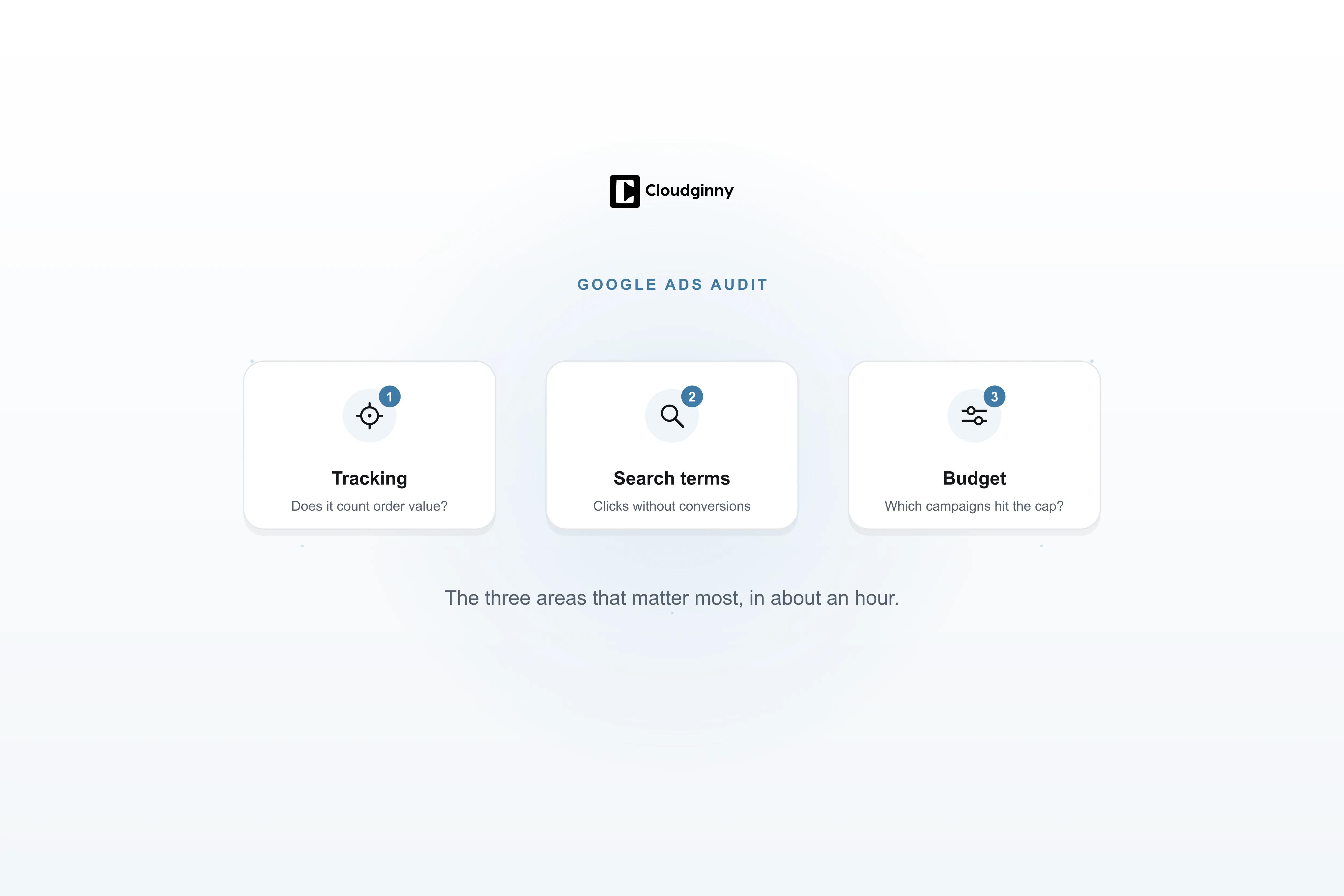
Search for "Google Ads audit" and what you mostly get is offers: agencies that will examine your account for free, and a contract at the end. That does not answer the question underneath: what is actually being checked, how much of it can I do myself, and what does the rest cost? This article walks through the nine areas of an audit, says for each one where the money typically leaks, and attaches a checklist you can tick off.
Ryze AI is the cheaper multichannel autopilot: $89 flat for Google, Meta, TikTok and LinkedIn. Cloudginny is a Google Ads specialist with a German company behind it, Merchant Center depth and an approval model. This comparison puts prices, channels and control side by side, and says plainly where Ryze wins.
Search for Google Ads management software and you land on Optmyzr, Adalysis or Opteo. They are good tools, just built for somebody who already knows Google Ads: a marketer who writes rules and knows what to do with forty improvement suggestions. Most online shops do not have that person. This article explains what the classic platforms actually do, what an AI agent does differently, which model fits when, and what neither of them can do.