ChatGPT Ads in Europe: What the Launch Means for Online Shops
Christian Beeking
Co-Founder, Cloudginny
August 25, 20266 min read
As of 25 August 2026. The channel is one day old, we update this article whenever something material changes.
It is official: ChatGPT now shows ads in Europe. After six months of piloting in the US and eight further markets, OpenAI switched the channel on across 31 European countries on 24 August 2026, among them Germany, Austria, France, Italy and the Netherlands. For the first time there is a second large advertising channel that reaches people in the middle of their purchase research, and a lot of open questions for online shops. Here are the facts, the costs, the one difference to Google Ads that matters most, and an honest assessment of whether you need to act now.
What happened? ChatGPT now shows ads across Europe
ChatGPT Ads is OpenAI's advertising platform, live in 31 European markets since 24 August 2026. The ads appear below the ChatGPT answer, are labelled as sponsored and do not influence the answer itself. They are visible only to adult users on the free tier and the Go plan, every other plan stays ad free.
What makes the channel interesting is the context. According to OpenAI, around 20 percent of ChatGPT conversations have a commercial intent. People there do not type three keywords, they describe in full sentences what they are looking for, what their budget is and what matters to them. That is a depth of purchase intent a classic search query rarely delivers, and the reason the large agency networks have been in the pilot for months.
Who sees the ads and what they look like
Delivery is deliberately limited. Ads are shown only to signed-in, adult users on the free and the Go tier. Plus, Pro and all business plans stay ad free, as do accounts under 18. On top of that, free users can opt out of advertising entirely in exchange for lower usage limits, and OpenAI places no ads next to sensitive topics such as health or politics. During the US pilot, according to the company, fewer than one in five eligible users saw any ads on a given day. The inventory is therefore considerably smaller than ChatGPT's user numbers suggest.
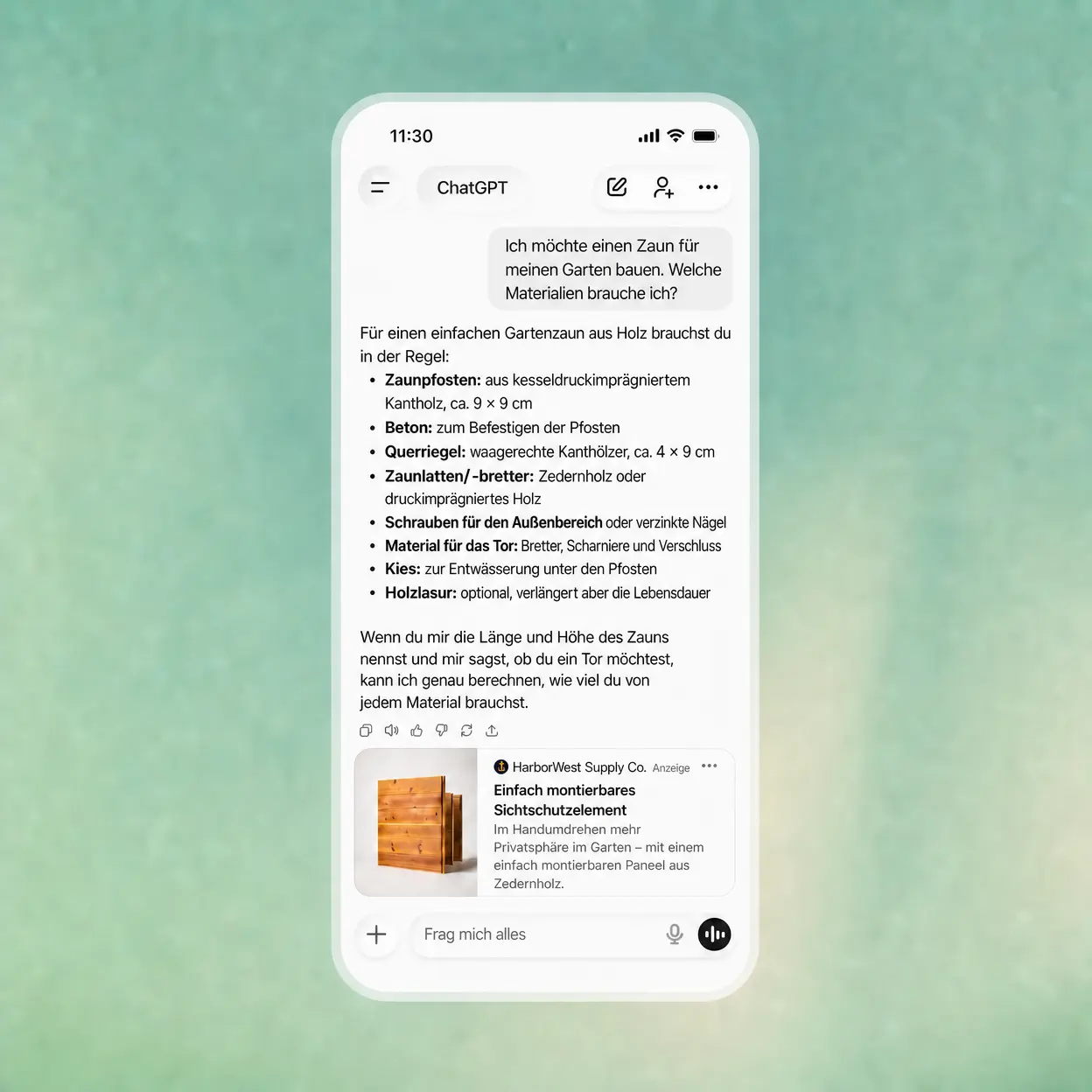
The ad format itself is plain: advertiser name with favicon, headline, body text, image and a landing page link, placed below the answer and visually separated from it. There are no product carousels, no prices, no availability, so nothing that resembles a shopping ad. What you advertise is a message with a destination URL, not a product feed.
What it looks like in practice: the ad sits below the answer, labelled as sponsored, with favicon, headline, body text and image. The answer above it stays untouched. Source: ads.openai.com (German market example)
Context hints instead of keywords: the difference that matters
Anyone coming from the Google Ads world looks for the keyword field first, and does not find one. Delivery is steered through so-called context hints at ad group level: descriptions of the conversations, topics and situations in which your offer is relevant. OpenAI states explicitly that these are not exact match keywords and that there is no guarantee of appearing in particular conversations. The hints are pointers to an AI system that decides for itself when an ad fits.
That is a different way of working than Google. Instead of buying „trail running shoes men buy“, you describe situations: „User asks for trail shoe recommendations for beginners, compares models or looks for gear for a first trail race.“ The quality of your campaign depends on how well you anticipate your audience's conversations, not on how complete your keyword list is. And because there is no delivery guarantee, measurement matters more than setup: you write, you measure, you sharpen.
The two systems side by side:
ChatGPT Ads
Google Ads
Steering
Context hints: topics and situations, no delivery guarantee
Keywords and product feed
Formats
One text ad with an image below the answer
Text, Shopping, PMax, Video, Display
Bidding
CPM, CPC, oCPC; recommendation 3 to 5 $ per click
CPC with Smart Bidding on ROAS or CPA targets
Targeting
Geo and custom audiences
Geo, audiences, feed signals, remarketing
Measurement
Pixel, conversions API, UTM
Full conversion and auction reporting
Access
For now only via OpenAI and agencies
Self-service and an open API
What do ChatGPT Ads cost?
Billing runs on two models with one maximum bid per ad group each: CPM for reach goals or CPC for click goals, plus a conversion-optimised CPC (oCPC) for accounts with tracking in place. For getting started on CPC, OpenAI recommends in its help centre a maximum bid of 3 to 5 US dollars per click. OpenAI has not published separate European prices in euros so far. There are no official benchmarks for CPCs, CTRs or ROAS by industry yet, and OpenAI says so itself.
To put that in perspective for online shops: across our client accounts the median click price for Shopping and Performance Max ads is 0,42 €. The recommended ChatGPT entry range is therefore eight to twelve times a typical shopping click. It is not a fair one-to-one comparison, because a ChatGPT click can carry a purchase intent the user has described in detail, but it sets the bar: a ChatGPT click has to convert many times better than a shopping click to deliver the same effect per euro. The channel still has to prove that.
Booking: how you get ads today
This is where the most important limitation of the launch sits: 24 August started the selling, not the self-serve tool. Campaigns run through the OpenAI Ads Solutions Team, through partner agencies (the large networks among them) and through technology partners. The self-service Ads Manager, which will let smaller advertisers book directly, is due later this quarter according to OpenAI. If you want to be on the list, you can sign up at ads.openai.com.
For most small and mid-sized shops this means in practice: before the self-service launch the channel is effectively closed, unless you go through an agency with the right access and the matching minimum budgets. That takes some urgency out of the date for SMEs, and it gives you time to do the homework before the booking tool arrives.
Targeting, privacy and what advertisers never see
Targeting is deliberately narrow at launch: geographic targeting and custom audiences. To match ads, OpenAI uses signals such as the conversation topic, earlier chats and the user's previous ad interactions.
The point that matters for European retailers and their customers: advertisers get no access to chats, histories or memories. Names, email addresses, IP addresses and locations stay with OpenAI, and only aggregated performance data is passed on. Users can switch off personalisation, hide individual ads and delete advertising-related data. On top of that comes the European framework that delayed the EU launch in the first place: GDPR-compliant consent, the public ad archive required by the Digital Services Act, and the disclosure duties from the EU AI Act. So if a customer asks you about the new advertising, you can answer cleanly: the advertiser does not see your conversations.
Measurement: pixel, conversions API and the simple route
For measurement OpenAI offers three routes: the OpenAI pixel on your own website, a conversions API for server-side tracking, and third-party integrations. If you already run server-side tagging, Stape has a ready-made OpenAI Ads pixel tag. And the simplest start needs no new technology at all: UTM parameters on your landing page URLs survive the ad click, so ChatGPT traffic shows up cleanly separated in the analytics setup you already have. The platform's own reports currently cover impressions, clicks, spend, CTR, average click and thousand-impression prices, plus conversions.
Is it worth it for online shops? The honest assessment
In short
The sober answer for most SME shops: not yet, but worth a test soon. Four reasons to hold back, and one against.
First, access: without a self-service manager the channel is effectively shut for small budgets. Second, the format: there are no product ads, no feed, no prices in the creative, so e-commerce is missing exactly the format that brings the lion's share of revenue on Google. Third, reach: only free and Go users see ads, they can opt out on top of that, and even in the US pilot fewer than one in five eligible users saw ads on a given day. Fourth, the evidence: OpenAI itself names no performance benchmarks yet, and demand from the first advertisers is so far driven more by reach and presence than by proven performance. That parts of the user base react with irritation to the advertising, and that competitors already sell their ad-free experience as an argument, belongs to the picture too.
Against that stands one strong argument: the quality of the moment. Someone asking ChatGPT for product advice is in the middle of the decision, and the ad slot right below the answer faces little competition while most advertisers are still hesitating. Our recommendation is therefore: sign up now, put the tracking basics in place (a UTM concept is enough to start with) and run a small, cleanly measured test when self-service opens, without pulling budget out of a Google setup that works. Google Shopping stays the performance core of every online shop for the foreseeable future, the fundamentals are in our guide to Google Shopping, and where the AI channels are heading in general is something we wrote up using the Universal Cart as an example: what Google's AI cart means for retailers.
And what is Cloudginny doing about it?
The honest answer, even though „integration coming soon“ would sound better: Ginny gets no ChatGPT Ads connection for now, for a simple reason. There is nothing yet for a tool to dock onto. As long as booking runs through the solutions team and agencies, there is neither self-service access nor an API open to tools. On top of that, the channel still has to prove for SME e-commerce that it delivers conversions rather than reach. Ginny therefore stays focused on what demonstrably brings revenue for online shops: Google Ads and Microsoft Ads.
What we do instead: we watch the channel systematically, we will test it ourselves once self-service opens, and we will reassess a connection as soon as two things come together, namely open API access and the first solid e-commerce data. When both are there, you will read it here first.
Frequently asked questions about ChatGPT Ads
Who sees ChatGPT Ads?
Only signed-in, adult users on the free tier and the Go plan. Plus, Pro and all business plans stay ad free, and free users can opt out of advertising in exchange for lower usage limits.
What does a click on ChatGPT Ads cost?
OpenAI recommends a maximum bid of 3 to 5 US dollars per click to start with, and bills alternatively per CPM or conversion-optimised CPC. There are no official benchmarks by industry yet. For comparison: a shopping click costs 0,42 € at the median across our client accounts.
Can I book ads myself yet as a shop?
Not yet. Booking currently runs through the OpenAI Ads Solutions Team, partner agencies and technology partners. The self-service Ads Manager is due later this quarter, and you can already sign up at ads.openai.com.
Do the ads influence ChatGPT's answers?
No. The ads sit below the answer, are labelled as sponsored and run on separate systems according to OpenAI. Paid placements do not change the answer.
Do advertisers see my chats?
No. Advertisers get no access to chats, histories or memories, only aggregated performance data. Names, email addresses and IP addresses stay with OpenAI, and users can switch off ad personalisation.
Should my online shop get in now?
Sign up yes, move budget no. Without self-service access, a product ad format and performance benchmarks, the channel is still an observation post for SME shops. What makes sense now is preparation: settle your UTM concept and run a small, cleanly measured test once the Ads Manager opens.
Christian Beeking is co‑founder of Cloudginny, the AI agent for automating Google Ads in e‑commerce. Before Cloudginny, the team managed more than 100 million euros in Google Ads budget for brands such as MediaMarkt, Cisco and Bose, and has now poured that knowledge into Ginny. Cloudginny is an official Google Partner, a WebStollen partner and part of the German Accelerator.
Search for "Google Ads audit" and what you mostly get is offers: agencies that will examine your account for free, and a contract at the end. That does not answer the question underneath: what is actually being checked, how much of it can I do myself, and what does the rest cost? This article walks through the nine areas of an audit, says for each one where the money typically leaks, and attaches a checklist you can tick off.
Ryze AI is the cheaper multichannel autopilot: $89 flat for Google, Meta, TikTok and LinkedIn. Cloudginny is a Google Ads specialist with a German company behind it, Merchant Center depth and an approval model. This comparison puts prices, channels and control side by side, and says plainly where Ryze wins.
Search for Google Ads management software and you land on Optmyzr, Adalysis or Opteo. They are good tools, just built for somebody who already knows Google Ads: a marketer who writes rules and knows what to do with forty improvement suggestions. Most online shops do not have that person. This article explains what the classic platforms actually do, what an AI agent does differently, which model fits when, and what neither of them can do.