
Quick answer: The best Google Ads automation tool for an online shop depends on your shop size, platform and how much control you want to keep. For JTL and Shopify shops in the $500 to $20,000/month range that want Shopping-focused automation without agency overhead, Cloudginny is purpose-built. It focuses Performance Max on the Shopping placement, structures campaigns by margin and supports JTL and Shopify directly. For agencies managing many accounts or teams wanting hands-on feed audits, Optmyzr offers the deepest control. For fully autonomous, multi-platform management, Ryze AI fits, while Madgicx suits Meta-first advertisers who run Google as one channel among several. Opteo suits smaller shops wanting guided recommendations, Adalysis excels at account auditing, and Skai serves enterprise omnichannel governance. The reason tool choice matters more for e-commerce than for any other business type: Google Shopping is the dominant paid format for online shops. It delivers the cheapest qualified traffic and the highest ROAS of any paid format for product businesses, so feed quality, Shopping/PMax control and margin-based structure decide whether you make money or burn it.
This guide compares the leading tools specifically through an e-commerce lens, with a focus on what actually moves the needle for JTL and Shopify shops. We have kept it neutral where it counts: transparent criteria, honest trade-offs for every tool (including our own) and real sources. Where we argue that Cloudginny is the best fit for JTL and Shopify shops, we explain why with data, not by talking the others down.
| Tool & e-commerce fit | Shopping & feed focus | Shop-system fit (Shopify/JTL/Shopware) | Automation style | Best-fit shop size | EU/GDPR notes |
|---|---|---|---|---|---|
| Cloudginny 4.8 | High (Shopping-focused PMax, margin-aware, keyword curation) | High (JTL & Shopify focus) | Agentic assistant (Ginny) + one-tap | $500-$20k/mo spend | GDPR, external DPO (heyData) |
| Optmyzr 4.1 | High (feed audits, PMax tooling) | Generic (no shop-specific focus) | Rules + portfolio tools | Moderate-high spend / agencies | Public DPA, SCCs |
| Ryze AI 3.5 | Medium (one of many channels) | Generic + Shopify autopilot | Fully autonomous | Multi-channel / agencies | Privacy policy cites GDPR |
| Madgicx 3.2 | Medium (multi-channel, Meta-first) | Generic (Meta/social focus) | Fully autonomous (AI marketer) | Multi-channel / Meta-first | Privacy policy cites GDPR |
| Opteo 3.3 | Medium (recommendation-led) | Generic | Guided recommendations | Smaller accounts | Standard EU privacy pages |
| Adalysis 3.1 | Medium (audit-focused) | Generic | Auditing & alerting | QA-focused teams | Standard EU privacy pages |
| Skai 3.5 | Medium-high (enterprise) | Generic (enterprise) | Portfolio governance | Enterprise | EU data/security pages |
How we score: each tool's e-commerce fit score is weighted across the six criteria further down (Shopping & feed 30%, shop-system fit 20%, automation & guardrails 15%, compliance 15%, pricing 10%, ease 10%). A lower score means less of a fit for a JTL or Shopify shop in the $500 to $20,000 range, not lower quality overall: several of these tools are excellent for agencies or enterprises.
Interpretation: Optmyzr offers the deepest publicly documented PMax and feed tooling for those who want granular, hands-on control. Ryze and Madgicx lean into cross-platform, fully autonomous management, with Madgicx weighted toward Meta and creative. Adalysis and Opteo are strong for auditing and guided optimisation respectively. Skai serves enterprise governance. Cloudginny is the most specialised for JTL and Shopify shops that want Shopping-focused automation in the SMB/mid-market range.
 Best for JTL & Shopify Shopping
Focus: Launching and optimising Google Ads (RSA, Shopping, PMax) for e-commerce shops without prior expertise, with a clear focus on the $500 to $20,000/month spend range and on JTL and Shopify merchants.
Standouts: Cloudginny's core is Ginny, an agentic AI assistant for Google Ads. Think of it as a conversational agent you give a task to in plain language. Ginny proposes the concrete changes (building campaigns, creating ad groups, setting negative keywords, restructuring, optimising), you approve them and Ginny then implements the approved changes in your account for you. This keeps you in control of every change while removing the manual work, a deliberate middle ground between rule-based dashboards (where you configure everything yourself) and fully autonomous tools (where changes happen without your sign-off). Beyond that, campaign creation runs in under 2 minutes, with one-tap optimisations and daily tuning. PMax campaigns built by Cloudginny focus specifically on the Shopping placement rather than spraying budget across Gmail, YouTube and Discover. Automatic keyword curation avoids irrelevant spend and campaigns are structured by margin or ROAS rather than as one undifferentiated catalogue. A documented Partner API (REST, server-to-server) lets you pull your aggregated Google Ads and Microsoft Ads KPIs into your own dashboards or partner tools. Your data stays portable, no lock-in. GDPR compliant with an external DPO (heyData). The team previously managed over $100 million in Google Ads budget for brands such as MediaMarkt, Cisco and Bose.
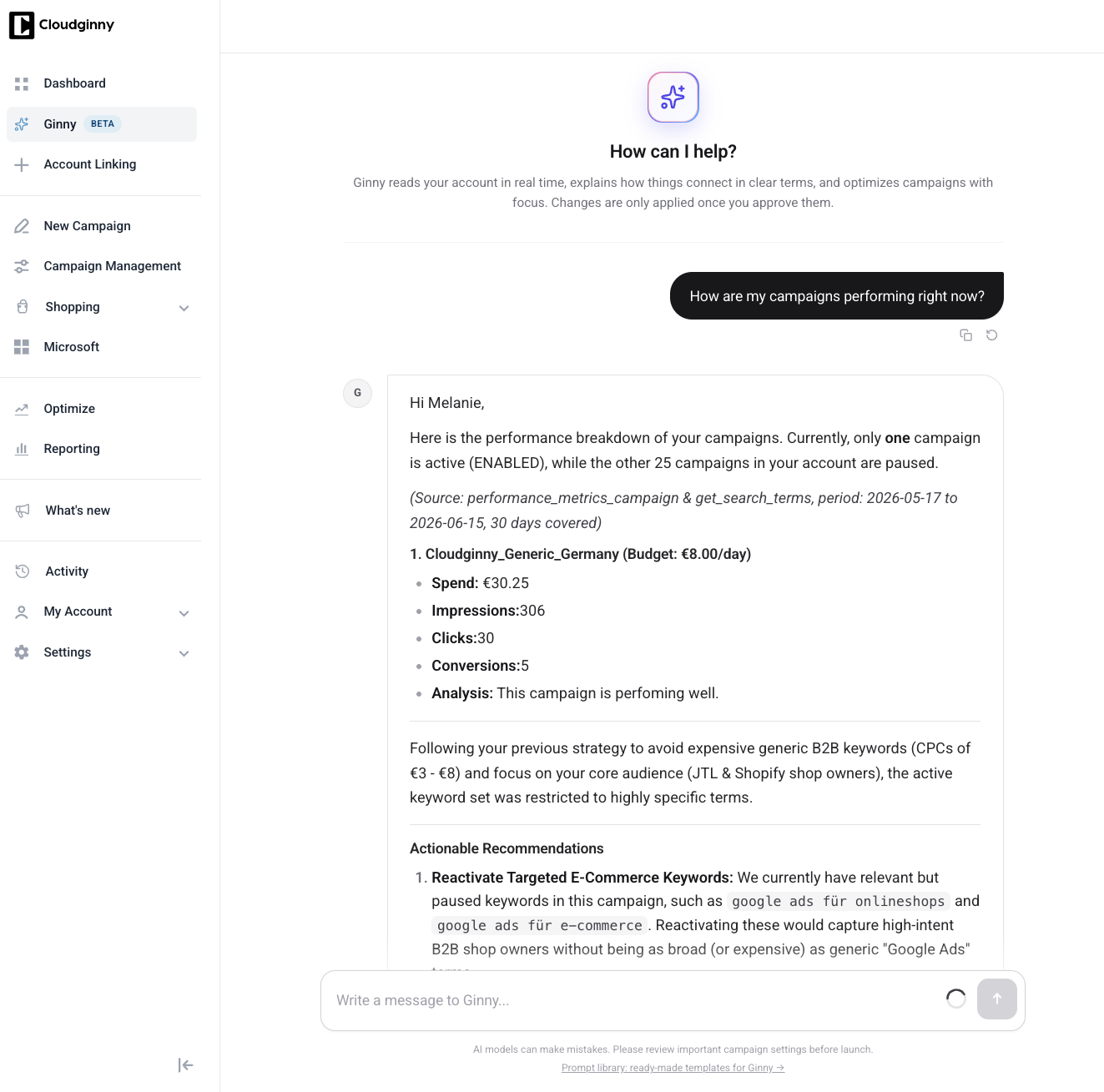
E-commerce results: Cloudginny clients reach an average Shopping conversion rate of 2.32%, roughly 21% above the industry average of 1.91%; the top client sits at 12.3%. Case studies span both platforms: Aventon (Shopify) and Markeking (JTL).
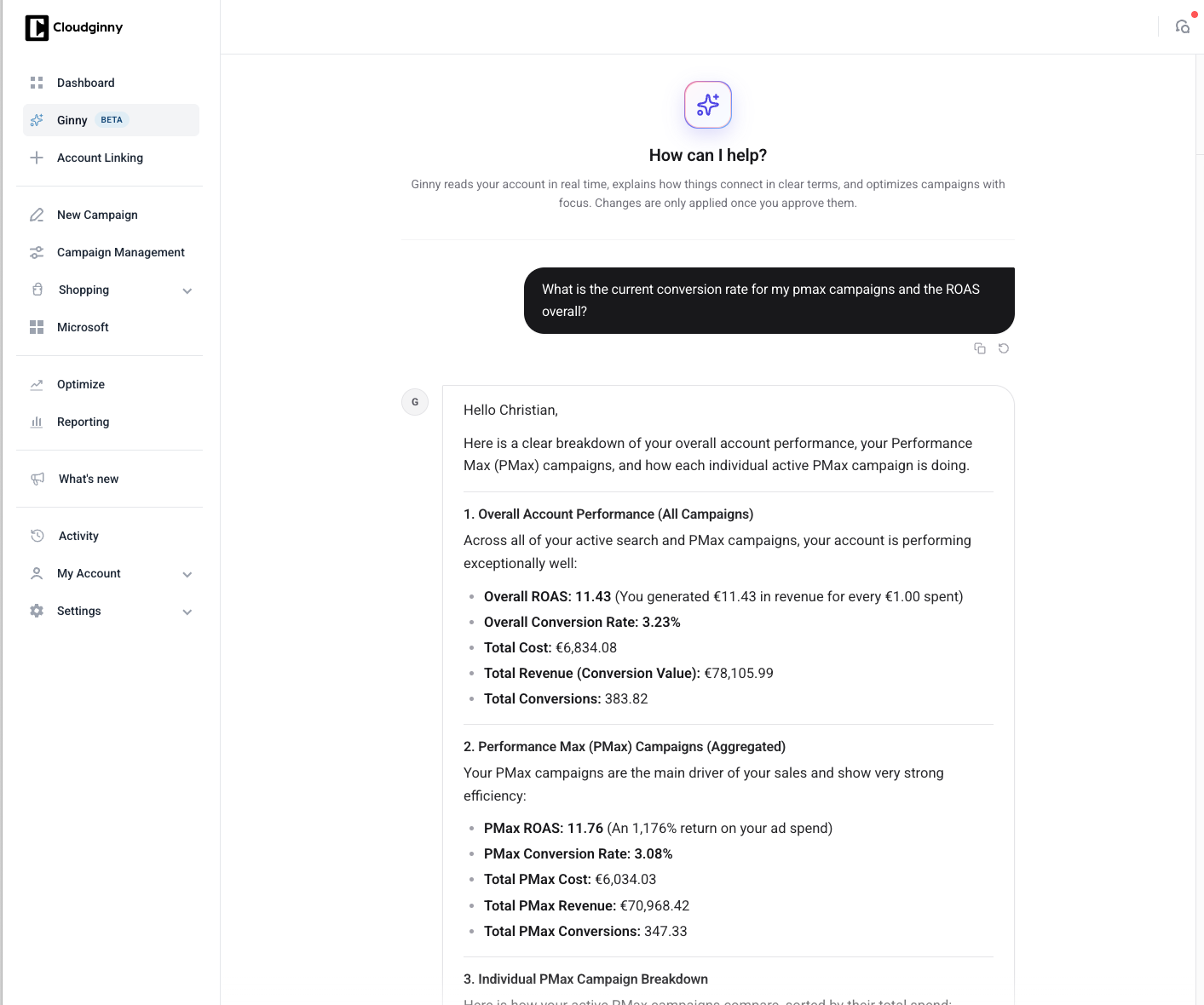
Trade-offs: Integrations beyond CSV (e.g. direct GA4/Looker connectors) are not publicly disclosed. Built for the SMB/mid-market e-commerce range, not for enterprise omnichannel governance.
Best for: JTL and Shopify shops in the $500 to $20,000/month range that want Shopping-focused automation, fast launch and clear reporting without agency or freelancer overhead.
Focus: Cross-publisher PPC operations and automation, with a strong rule engine and genuinely deep PMax utilities.
Standouts: PMax creation and insights (e.g. channel-distribution widget), feed audits, budget controls, AI-suggested structures. 14-day free trial. Documented coverage policy and a public DPA. Manages billions in ad spend annually.
Trade-offs: Social integrations require an add-on, and spend/account overages can kick in as you scale. The depth is powerful but has a learning curve more than most small shop owners want.
Best for: Agencies and in-house teams needing granular control, feed audits and cross-account workflows, especially at moderate to high spend.
Focus: Autonomous, multi-platform ad management (Google, Meta, TikTok, LinkedIn and more) that makes changes automatically rather than only flagging them.
Standouts: Fully autonomous optimization with guardrails, fast setup (under 5 minutes by their account), a unified dashboard across many platforms, and bundled SEO and landing-page features. Used by a large base of marketers across many countries.
Trade-offs: The broad, "automate everything across every platform" positioning is the opposite of specialised e-commerce feed and Shopping nuance, which is one capability among many rather than the core focus. Full autonomy suits teams comfortable handing over control; shops that want to understand and approve changes may prefer more transparency.
Best for: Multi-channel marketers and agencies who want hands-off automation across several ad platforms from one place.
Focus: AI-powered, multi-channel ad automation with a strong heritage in Meta (Facebook and Instagram) advertising, plus creative intelligence and autonomous budget optimisation.
Standouts: Autonomous optimisation (an "AI marketer" style of automation), creative analysis and ad-library tooling, one-click reporting, and coverage across several ad platforms from a single dashboard. Free trial available.
Trade-offs: The core strength and reputation sit with Meta and creative automation. For a Google Shopping e-commerce use case, Google is one channel among many rather than the specialised focus, so feed quality, Shopping/PMax control and margin-based structure get less dedicated attention than from a Shopping-first tool. Confirm the current depth of its Google Ads and Shopping features before committing.
Best for: Meta-first and multi-channel advertisers who want autonomous social and creative automation and treat Google Ads as one of several channels.
Focus: Simplified monitoring and optimisation for smaller accounts, with clear, actionable recommendations.
Standouts: Beginner-friendly interface, focus on the high-impact basics (bid adjustments, negative keywords, budget allocation), quick setup. Lower entry pricing than the heavier platforms.
Trade-offs: Less depth on e-commerce-specific feed and PMax tooling than Optmyzr; recommendation-led rather than autonomous.
Best for: Smaller shops and lean teams that want straightforward, guided optimisation without a steep learning curve.
Focus: Systematic account auditing and monitoring, like an always-on PPC auditor.
Standouts: Large library of prebuilt alert templates, strong error detection (broken URLs, quality-score drops, budget issues, structural problems), continuous quality assurance.
Trade-offs: Auditing and alerting are the core strength. It surfaces problems rather than autonomously fixing or building campaigns. Best paired with someone who acts on the findings.
Best for: Shops and teams that want rigorous, continuous account health checks and quality assurance.
Focus: Omnichannel enterprise platform (search, social, retail media) with governance and budgeting at scale.
Standouts: Enterprise budgeting and portfolio tools, published data-protection pages referencing EU considerations, strong multi-account governance.
Trade-offs: Quote-based, sales-led pricing and heavier implementation. Almost always overkill for an SMB or mid-market online shop.
Best for: Large advertisers and enterprises needing omnichannel governance and portfolio budgeting.
| Tool | Entry signal | Billing model | Free trial? |
|---|---|---|---|
| Cloudginny | Free trial, then from $99/mo | Flat tiers by spend band | 7-day free trial |
| Optmyzr | Published tiers; overage rules | Subscription, spend/account tiers | Yes (14 days) |
| Ryze AI | Free trial, then subscription | Subscription | Yes |
| Madgicx | Free trial, then subscription (tiered) | Subscription | Yes |
| Opteo | Lower entry tier | Subscription | Yes |
| Adalysis | Mid entry tier | Subscription | Typically yes |
| Skai | Custom/quote | Contractual | Demo-led |
To put the spend in context: an agency for ongoing Google Ads management typically starts around $1,500/month, while a tool like Cloudginny starts at $99/month. That is a meaningful difference for a shop in the $500 to $20,000 spend range.
Most Google Ads automation tools are built for a broad audience: agencies, lead-gen businesses, enterprises. That breadth is exactly the problem for an online shop. E-commerce lives and dies by the product feed and Shopping campaigns, and those need specialised handling that generic tools treat as an afterthought.
The numbers make this concrete. Google Shopping is the dominant paid format for e-commerce. It delivers far cheaper traffic than search ($0.66 vs $5.26 average CPC) and consistently the highest ROAS of any paid format for product-based businesses. Across the Cloudginny client base, e-commerce shops generate around 90% of their revenue through Shopping or Performance Max campaigns. Search intent remains the highest-converting traffic source in online retail.
And the bar is rising. In 2025, the median e-commerce ROAS on Google Ads sat at roughly 3.5:1, but median ROAS declined about 10% year over year as competition intensified. Median CPA climbed 12.35% to $23.74, CTR improved by 7.49%, but conversion rates fell 9.28%. In plain terms: shoppers are clicking more, converting less, and each customer costs more to acquire. E-commerce search CPC rose 33% year over year.
That environment punishes unsupervised, generic automation and rewards tools that understand e-commerce structure. The single most common architecture failure we see: one Shopping campaign running all 3,000 SKUs on a single daily budget, with brand search terms not excluded. The algorithm has no signal on which products to prioritise, so it spreads spend evenly across margin-killers and bestsellers alike. This is an architecture problem, and it is exactly the kind of thing a Shopping-focused tool should fix.
We weighted these criteria for online shops specifically, not for agencies or lead-gen:
Note: Google keeps expanding AI features (AI Max, more PMax visibility). When you evaluate any tool, ask whether it adds real incremental control for your shop or merely replicates Google's native capabilities.
Before you pick a tool, know what "good" looks like for an online shop in 2026. Use these as directional guides. Your real targets depend on margin, AOV and category.
The key takeaway: a "good" ROAS is meaningless without your margin. Always evaluate Shopping performance in the context of your gross margin, which is exactly why margin-aware campaign structure matters so much for e-commerce.
We bring it back to the e-commerce reality. Most tools in this list are generalists. They serve agencies, lead-gen and enterprises, and Shopping is one capability among many. For an online shop, that breadth is a weakness, because the levers that decide whether you make money are specific: a clean product feed, Shopping-focused campaigns, margin-aware structure, and platform fit.
That is exactly where Cloudginny is built differently:
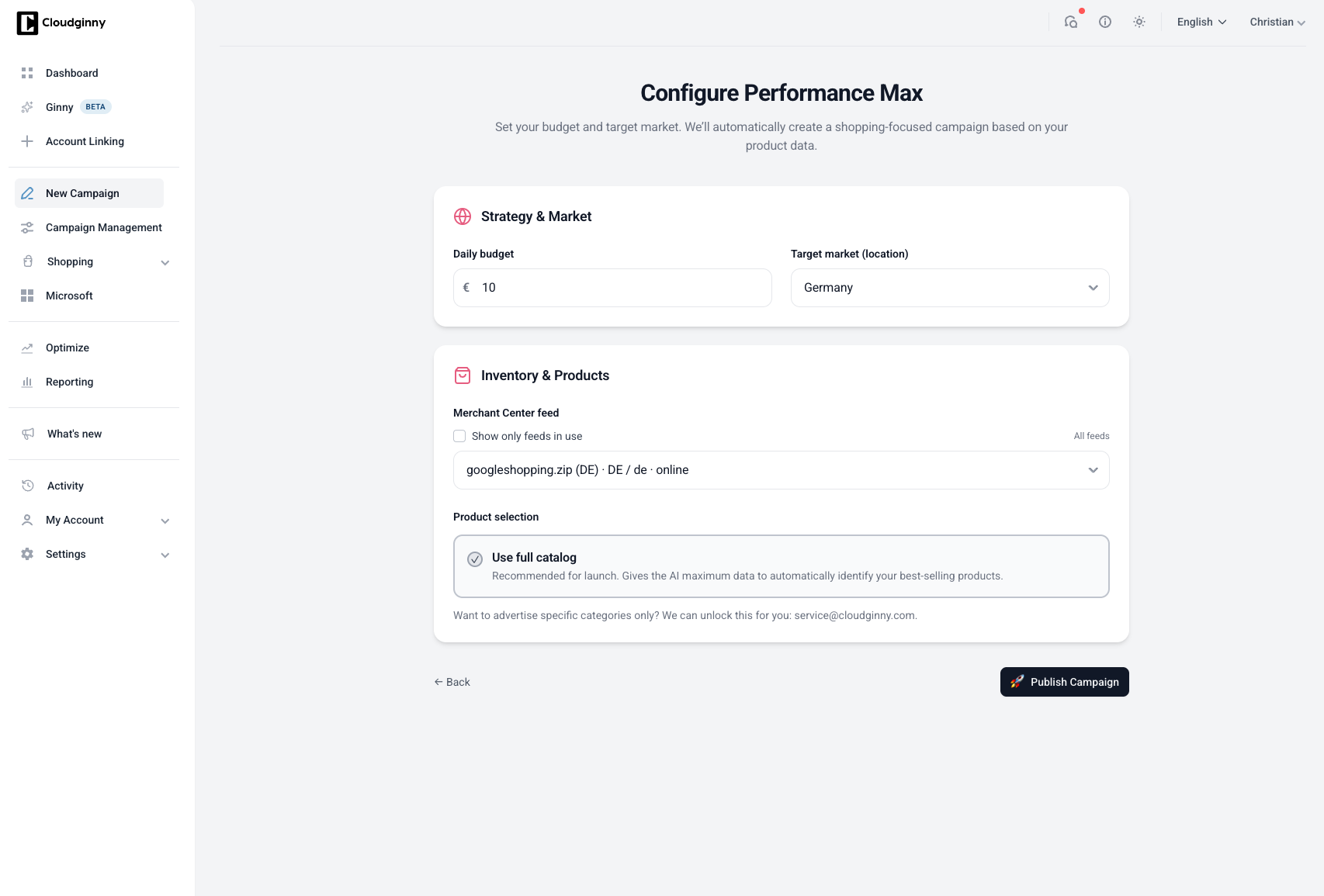
To be clear about the trade-off: if you are an enterprise that needs omnichannel portfolio governance, or an agency that wants to run deep feed audits by hand, a heavier platform like Optmyzr or Skai will serve you better. Cloudginny is the best fit for the specific job of running Google Ads for a JTL or Shopify shop without agency overhead, and for that job, specialisation beats breadth.
There is no single best tool for every shop. For JTL and Shopify shops in the $500 to $20,000/month range that want Shopping-focused automation without agency overhead, Cloudginny is purpose-built. For agencies managing many accounts or wanting hands-on feed audits, Optmyzr is stronger. For fully autonomous multi-platform management, Ryze fits, while Madgicx suits Meta-first advertisers running Google as one channel among several. Match the tool to your shop size, platform and how much control you want to keep.
Look for Shopping-focused automation, a fit with your spend range, and clear reporting. Cloudginny supports Shopify directly and targets the $500 to $20,000/month range. Opteo is an option for guided, action-it-yourself optimisation. The most important factor for any Shopify store is feed quality and margin-aware Shopping structure.
JTL shops depend heavily on a clean product feed and margin-based Shopping structure. Cloudginny is built with JTL in mind and focuses PMax on the Shopping placement; Optmyzr is a strong hands-on alternative for feed audits and PMax tooling.
Check for a published Data Processing Agreement, Standard Contractual Clauses for transfers, and clear disclosures on data hosting and processing. An external DPO is a positive signal. Many vendors publish these pages. Confirm before you commit, especially as a European shop.
Usually yes, for the SMB/mid-market range. Agencies typically start around $1,500/month, while tools like Cloudginny start at $99/month. The trade-off is hands-on strategic guidance (agency) versus automated, ongoing optimisation you oversee yourself (tool). For most shops in the $500 to $20,000 range, a specialised tool delivers the operational work at a fraction of the cost.
Yes. PMax is Google's goal-based campaign type spanning all its channels. Tools differ in how much visibility and control they add; some (like Optmyzr) provide channel-distribution insights and audits, while others (like Cloudginny) focus PMax on the Shopping placement for e-commerce. Always confirm each vendor's current PMax coverage.
This varies by vendor and matters most for larger shops, agencies and partners. Cloudginny offers CSV export plus a documented Partner API (REST, server-to-server) that returns aggregated Google Ads and Microsoft Ads KPIs in a unified JSON format. Useful if you run your own reporting or partner dashboard and want to avoid lock-in. If data portability matters to you, ask each vendor whether they provide a documented API, not just an in-app export.
All benchmark figures are industry averages and serve as orientation. Actual performance depends on niche, margin and setup. This guide is updated regularly. As of: June 2026.
Christian Beeking is co-founder of Cloudginny, an AI agent for automating Google Ads in e-commerce shops. Cloudginny is a partner of WebStollen and part of the German Accelerator. Before Cloudginny, Christian and the team spent the past years managing more than $100 million in Google Ads budget for brands such as MediaMarkt, Cisco and Bose, and have now poured that knowledge into an AI agent.
AI agent for Google Ads in e-commerce
© 2026 Cloudginny. All rights reserved.